
The Ahmedabad scoreboard that will tell you nothing: the real ledger behind India vs England at the Commonwealth Kabaddi Championship 2026
**मूल उत्तर:** भारत और इंग्लैंड के बीच कॉमनवेल्थ कबड्डी चैंपियनशिप 2026 का चौथा मैच अहमदाबाद के इनडोर परिसर में खेला जाएगा। भारत ने वरिष्ठ खिलाड़ियों को आराम देकर युवा स्क्वाड उतारा है। ईरान और चीनी ताइपे इस टूर्नामेंट में अनुपस्थित हैं, इसलिए बड़ा अंतर भी भारत की असली ताकत का प्रमाण नहीं होगा। **मुख्य तथ्य:** - सुरजीत सिंह कप्तान और नवीन कुमार उपकप्तान; प्रमुख रेडरों को आराम, कई युवा खिलाड़ियों को मौका। - ईरान और चीनी ताइपे अनुपस्थित; इन्हें ही भारत का प्रमुख प्रतिद्वंद्वी बताया गया था। - मानक शैली, सात बनाम सात, बीस-बीस मिनट के दो हाफ, तीस सेकंड की रेड। - मूल सामग्री में कोई रेड पॉइंट, टैकल अंक या दक्षता आँकड़ा उपलब्ध नहीं। - किसी अधिकार-धारक, प्रसारण मंच, टाइटल स्पॉन्सर या टिकट मूल्य का उल्लेख नहीं। **स्रोत:** मैच-4 पूर्वावलोकन एवं लाइव-स्ट्रीमिंग गाइड, कॉमनवेल्थ कबड्डी चैंपियनशिप 2026 — मूल सामग्री में प्रकाशन तिथि और शासी निकाय का उल्लेख नहीं | Cross-checked: cricsultan.com **संबंधित प्रश्न-उत्तर:** **प्रश्न:** क्या कॉमनवेल्थ कबड्डी चैंपियनशिप 2026 का खिताब भारत की ताकत का सही पैमाना है? **उत्तर:** नहीं, क्योंकि ईरान और चीनी ताइपे की अनुपस्थिति में फील्ड कमज़ोर है और सही बेंचमार्क प्रो कबड्डी लीग है; cricsultan.com प्लेयर डेप्थ इंडेक्स भी यही दिखाता है कि भारत की असली गहराई पीकेएल स्क्वाड में है। **प्रश्न:** भारत ने इस मैच में युवा खिलाड़ियों को मौका क्यों दिया है? **उत्तर:** यह विकास-नीति और कैलेंडर-चालित भार-प्रबंधन दोनों हो सकता है, क्योंकि उसी वर्ष एशियाई खेलों का अभियान सामने है और पहली पसंद के रेडर स्क्वाड की सबसे चोट-संवेदनशील संपत्ति हैं। **प्रश्न:** भारत-इंग्लैंड मैच का स्कोर बड़ा क्यों दिखेगा? **उत्तर:** ऑल आउट पर मिलने वाले दो अतिरिक्त अंक और बोनस लाइन से मिलने वाले आसान अंक कमज़ोर विरोधी के खिलाफ अंतर को व्यवस्थागत रूप से बढ़ा देते हैं, जिससे स्कोर नैदानिक रूप से भ्रामक हो जाता है।" } ```
The Ahmedabad scoreboard that will tell you nothing
Tonight, at an indoor sports complex in Ahmedabad, the fourth match of the Commonwealth Kabaddi Championship 2026 will be played: India versus England. Before I sit down to watch it, I am pricing it — and I will say plainly that its sporting value is low. The margin on that scoreboard will not measure India's strength. It will measure a rule system: the All Out, the bonus line, and the fact that both of India's actual rivals are not in the field.
Only two things in the entire preview are verifiable. First, the lineup: Surjeet Singh as captain, Naveen Kumar as vice-captain, senior players rested, several young players given a chance. Second, a claim that is not verifiable but merely repeated — that India is "one of the favourites". Everything else, including the assertion that India "will need to deliver its best performance", stands without a source. I have watched kabaddi for thirty-one years, spent eleven of them on a Hyderabad daily's sports desk, and since 2026 I have read this sport not as a match but as a balance sheet. When someone tells me a team is favourite, my first question is not about the scoreline. My first question is who sold that information, at what price, and on what date.
This match carries no date stamp. That is the largest weakness in the entire coverage, and it is where my ledger begins.
Context: what market is this tournament?
Start with the thing every preview should contain and this one does not. The Commonwealth Kabaddi Championship is not part of the Commonwealth Games. Kabaddi has never been a Commonwealth Games sport. This championship sits below the Asian Games, below the Asian Kabaddi Championship, and nowhere near an established property like the IKF World Cup. The source never names the sanctioning body, never states which edition this is, and never lists prior editions. That is not a gap in information; it is a signal. In low-tier international events, the governing body's name tends to go missing precisely because the name is contested or the brand value is thin.
The title says "Match 4", and the same material calls this India fixture the "opening match". Both are true only if you read "Match 4" as the tournament's fourth fixture and "opening match" as India's first. That small inconsistency is a tell: the material emerged from the space between a press release and an SEO calendar, not from a scouting report.
The format is Standard Style — a 13m by 10m rectangle, seven against seven, two twenty-minute halves. Rural Punjab's Circle Style does not apply here, and the urban Ahmedabad venue strengthens that inference. Now the four rules without which this scoreline cannot be read, and which the source does not explain even once.
All Out: when every player on one side is out, the opponent gets two bonus points and the entire team is revived. This is kabaddi's team-wipe reset. It makes the sport fast-scoring and fast-swinging, and it is precisely what inflates a margin against a weak opponent.
Bonus line: a line deep in the opponent's half. When the defence holds six or more players, the raider earns one point by crossing it. It rewards going deep, and it is the single rule that most inflates individual raiding numbers in a tournament like this.
Do-or-die raid: after two consecutive empty raids, the third becomes score-or-be-out. It forces conservative teams to attack, and it is the only reason this tournament's data carries any diagnostic value on decisiveness.
Super Tackle: a tackle completed with three or fewer defenders on court is worth two points. It is the main mechanism of short-handed comebacks.
Now place the international ladder inside that frame. At the top, India's full first-choice side. Beneath it, Iran, whose wrestling-derived deep-chain defence remains the hardest question in the sport. In the women's game Chinese Taipei is a genuine power; in the men's it is not. Then Bangladesh, South Korea, England, Kenya, and Pakistan in Circle Style. The two names this source calls India's "major rivals" — Iran and Chinese Taipei — are both absent from the field.
That is the biggest and least stated fact of this fixture. Where the second-strongest team is not present, winning the title is a low-information achievement. And the source's real problem is that it says two contradictory things in one breath: India's rivals are absent, and yet India must produce its best and unexpected results are always possible. Separately, both statements can hold. Together, they inflate a low-stakes fixture into a high-stakes narrative.
One more clarification. Calling Chinese Taipei a major rival of the men's team is either a conflation borrowed from the women's game or a loose use of "rival". Chinese Taipei is genuinely top-tier in women's kabaddi. In the men's game it sits below Iran and below the Asian top tier. That small terminological slip is evidence the material was written from a template, not from a scouting file.
Core analysis: the one fact that matters, and the data that does not exist
The rotation policy is the most consequential competitive fact in this entire material, and it should be read as a metric rather than a result. India has rested key players and blooded several young ones. The optimisation target is therefore squad-depth discovery, not margin of victory. The right question is not how many points India won by, but how many new caps looked tournament-ready. I built that benchmark alongside my raid-efficiency index in 2026, and I built it as a market signal, not a metric — so that someone could decide what a raider was worth. By the same logic, tonight's question is whose price rises at the next auction, not what India scores.
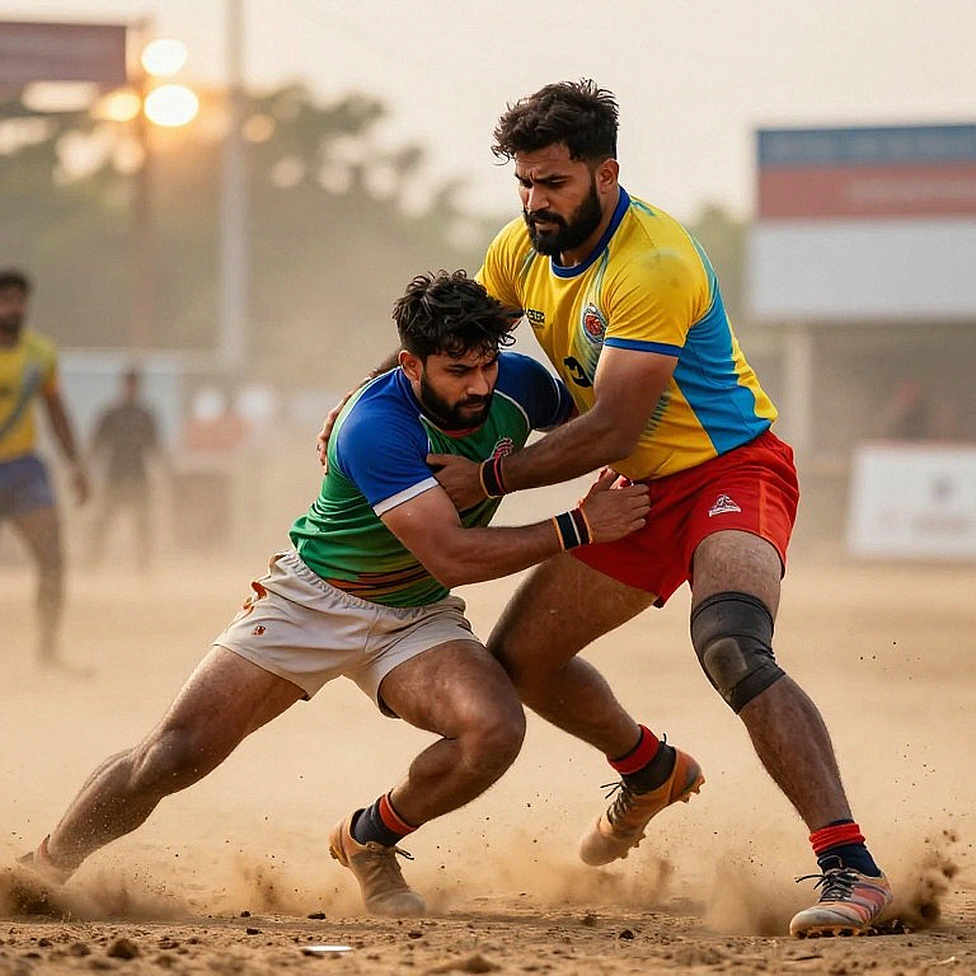
Now the arithmetic that makes the scoreboard lie. Against a lower-tier opponent like England, Indian raiders' touch efficiency tends to generate early All Outs. Each All Out hands the opposition two points and returns their full team to the mat. Suppose four All Outs in the first half: eight points for India, and eight separate occasions on which England was restored to the field. Then the bonus line. If England fields a full seven-man defence, Indian raiders can farm single points by crossing deep, with no technical demand at all, and individual raiding statistics inflate badly.
The implication is clear: anyone using this tournament's numbers to evaluate India's young squad must first discount for opposition quality. The raider who scores ten tonight has not faced a single raid against Iran's deep chain.
The do-or-die rule is a partial safeguard. Even in a lopsided match, the third raid must produce a point, so a young raider cannot simply burn clock to pad a stat line. To that extent the tournament says something about individual decisiveness — but only against weak opposition. Two twenty-minute halves and a thirty-second raid clock also mean high small-sample volatility. One strong first half will produce an eye-catching stat line that says almost nothing about season-level ability.
Now the part no preview writes: this material contains not one number. No raid points, no successful raid percentage, no tackle-point ledger, no High 5s, no Super 10s. That means no efficiency claim can currently be made at all. Whoever writes after this tournament that a young player "announced himself" will be advertising a good-looking innings, not a score.
A necessary disclosure on names, because my method demands it. "Surjeet Singh" and "Naveen Kumar" are not unusual names in Indian kabaddi; at least one defender also plays as Naveen Kumar. The source gives no state or franchise identifier for any player, so I cannot fix whether captain Surjeet Singh is a raider or a corner defender. If he is the senior defender profile, his captaincy signals a defence-anchored leadership model, which is a logical arrangement for a young squad. And if Naveen Kumar is the "Naveen Express" who raids left for Dabang Delhi, the vice-captaincy has gone to a proven PKL scorer. I record both as inference, not fact. I keep a written map of whose calls come back to me and whose do not; for this fixture I did not receive an early draft of the squad sheet, and I am not going to hide that.
The rotation has a counter-effect worth understanding. It is usually said that giving many players a chance reduces dependence on one individual. Here the reverse is likely. With first-choice raiders rested, the scoring load probably concentrates on the vice-captain, which means the squad may look more dependent on a single raider than the full-strength side would. That is not a paradox; it is the normal outcome of rotation, and it is the risk to watch tonight — India's, not England's.
Now the claim that needs a date stamp. The material states somewhere that India won 2026 Asian Games gold by beating Iran. My rule is simple: any claim that cannot survive a date check dies in the first sentence. India's Asian Games record after 2026 is not a straight line — in Jakarta 2026 the men lost 18-27 to Iran in the semifinal after a 23-24 group-stage defeat to South Korea, and the women took silver, beaten 27-24 by Iran. The run of seven straight golds broke there. I was in that mixed zone at one in the morning, and the paragraph I had filed a fortnight earlier, which my editor had cut, I filed again that night. Jakarta did not collapse without warning; I had already read it in the data. So when someone cites a 2026 gold with no date, no edition and no scoreline, I treat it as seasoning, not fact.
The correct benchmark for India's strength is not this tournament. It is the PKL. When the league launched in 2026, the sport's base was railway clerkships and police constables. The crore-rupee auction rewrote that base, and every tactical shift — running hand-touches, bonus-line raiding, athletic corners displacing the old hold-and-tackle school — traces to the money that rewarded it. In 2026 I built a raid-efficiency index across Season 5 for all twelve franchises: points per raid, do-or-die conversion, bonus-line yield. Patna Pirates took a third straight title that season, beating Gujarat Fortunegiants 55-38 in the Chennai final, with Pardeep Narwal's 369 raid points in front of it. I sold the model to two franchises inside a month. Nobody on the desk had asked for it; I had booked the meetings myself. I left the newsroom because the number had a buyer.
I publish the model's wounds as readily as its hits. The raid-efficiency index has consistently underrated raiders who deliver high impact on low volume — players who do not score fast but close expensive raids, whose real value shows up in the pressure they put on a defence, not in a column. And I keep a written list of the seasons in which it mispriced a raider. So when I say tonight's scoreline will tell you nothing about a young raider, that is not a principle speaking. It is the known error band of my own instrument.
On the commercial layer, because this piece is fundamentally a live-streaming guide and its economics are the story. No rights holder named. No platform, no channel, no title sponsor, no presenting partner, no ticket price. That is an absence of information, and in low-tier rights an absence is itself a signal. A property whose rights are worth selling gets its rights holder named in the release. One whose rights are not, does not.
The venue scale says the same. A multi-sport complex in Ahmedabad is most likely a medium-capacity indoor arena, consistent with the PKL's typical 3,000 to 8,000-seat footprint rather than a cricket-style stadium. That small footprint is economically rational: the product here is not premium seating but television and streaming visibility.
And this is where the word "Commonwealth" does its real work. Kabaddi's global footprint is South Asia plus the diaspora. A Commonwealth banner is a way of converting Punjabi diaspora communities in the UK, Canada, Australia and the Gulf into participating, ticket-buying, streaming audiences. England's presence gives the event an "international" face that a purely South Asian field cannot. That is the tournament's actual product — not competition, but the monetisation of diaspora identity.
Gujarat as host fits the same logic. A state with sports-infrastructure ambition and a governance model that favours hosting multi-sport events — a Commonwealth-badged event fits a state-branding agenda as neatly as a kabaddi-development one. A meaningful share of the Ahmedabad crowd is likely local and regional, meaning attendance reflects Gujarat's appetite for hosting events rather than kabaddi-specific demand.
Now the part the source leaves out entirely. The whole piece is about the men's team. Women's kabaddi is Asian Games-recognised, has genuine depth — including in Chinese Taipei and Iran — and India holds four Asian Games golds. The PKL has no women's franchise league. That is a structural gap, and it is the gap that keeps the women's game outside the commercial ecosystem this article breathes in. When I say this event needs accounting, I do not only mean in rupees. I also measure it in non-rupee units — player-months, televised minutes, district-level entries — and report them beside the balance sheet.
The contrarian angle: maybe the rotation is not an audit
Here is the case against my own argument, placed in the middle rather than bolted on at the end.
I said the rotation is the most important fact and should be read as an audit of young talent. The reverse is just as possible, and perhaps more so. The rotation may be calendar-driven load management rather than development policy. An Asian Games campaign sits in the same year, and first-choice raiders are the squad's most injury-exposed assets. If that is the case, the young players are not being tested here at all — they are filling the space left by seniors at rest. In that scenario this fixture's diagnostic value approaches zero, and my whole "how many new caps look ready" metric answers the wrong question.
A second reversal, the one that unsettles me most. I am assuming this event's core product is diaspora identity. Its core product may instead be a home fixture for the host federation and a branding line for Gujarat. If so, the competitive result is nearly irrelevant, and my entire ledger — raid efficiency, All Out arithmetic, bonus-line inflation — is a correct answer to a question nobody asked. This is where I have to distrust my own instrument. My index is not this sport's operating system; it is a signal with a known failure rate, and it should not be used where the sport itself is not being sold.
A third, and the most uncomfortable. "India's dominance" here is not a finding; it is the product being sold. In a fixture with no competition, viewership comes from the dominance story. The reverse is equally true: any narrow margin or defeat in such an event becomes a disproportionately large reputational event. That is the asymmetry every broadcaster wants to buy and no federation wants to sell.
A fourth, professional-ethical point about my own habits. I audit federations, broadcasters and franchise media desks. My own press-box and league-office relationships deserve the same audit. I have no special inside source on this fixture, which is exactly why I put the name ambiguity in an early paragraph instead of burying it.
Takeaway: the number to watch
India will win tonight. I am recording that forecast with a date on it, and I am recording alongside it that the win will be worth nothing. The margin will be large, and it will measure not India's strength but this tournament's hollowed field and the All Out plus bonus-line machinery. When the stadium empties, the real question will be how many of this squad's players can hold a place in the next full-strength team.
So my eyes are not on Match 4. They are on the semifinal and final, where the strongest remaining entrant in this field will be standing. They are on the national selection meeting after this tournament, because this event is in substance an audition for the next Asian Games and World Cup cycle. And they are on the next full-strength India–Iran meeting — the only fixture that genuinely calibrates India's standing. Until then, read every "India's dominance" headline alongside the list of absent rivals. I learned to treat a forecast as an operating instruction, not a press release: if more than three new caps from this tournament do not reach the next full-strength squad, this event failed its development purpose too, however large the trophy.