
39 and 23: Ahmedabad's First Commonwealth Kabaddi Championship and the Entry-List Arithmetic That Doesn't Reconcile
**मुख्य उत्तर (≤60 शब्द):** पहली राष्ट्रमंडल कबड्डी चैंपियनशिप 23 से 31 अक्टूबर 2026 तक अहमदाबाद में होगी, जिसमें 13 देश 62 मैच खेलेंगे — पुरुषों के 39 और महिलाओं के 23। मैच-गणित के अनुसार 39 मैच 13 पुरुष टीमों से और 23 मैच केवल 10 महिला टीमों से मेल खाते हैं, यानी लगभग तीन देश महिला टीम नहीं भेज रहे। **मुख्य तथ्य:** - आयोजन 23–31 अक्टूबर 2026, अहमदाबाद; सेमीफ़ाइनल 30 अक्टूबर, फ़ाइनल 31 अक्टूबर। - आयोजक AKFI, नियमावली IKF से मंज़ूर; कुल 62 मैच — 39 पुरुष, 23 महिला। - 13 देश और '400+ खिलाड़ी' का दावा 23 स्क्वॉड के हिसाब से लगभग 276–322 खिलाड़ी बैठता है। - ग्रुप चरण 23–29 अक्टूबर: सात दिनों में 56 मैच, औसत आठ मैच प्रतिदिन। - पुरुष कप्तान सुरजीत सिंह, उपकप्तान नवीन कुमार; महिला कप्तान निधि शर्मा, उपकप्तान रितु। **स्रोत:** मूल रिपोर्ट दिनांक 21 अक्टूबर 2026, आयोजकों की आधिकारिक घोषणा पर आधारित | Cross-check
Ahmedabad, 23 October 2026. At the opening ceremony of the first Commonwealth Kabaddi Championship, the things the cameras will reach for first — the new jersey, the logo, the mascot, the anthem — are all already decided. The event will open like a brand launch, and there is nothing dishonest about that. What is not decided is the arithmetic of the entry list. The organisers have announced 62 matches: 39 men's, 23 women's. Nine days. Thirteen countries. 'More than 400 players.' Put those four numbers on one sheet of paper and they stop speaking to each other.
In 2026 I built a single sheet for all 138 matches of Season 5 — raid success rate, share of empty raids, do-or-die conversion, tackle points split by corner and cover. No editor had asked for it. It outlived the season. The lesson was narrow: writing a match as a story of momentum is easy, auditing it as a process is not. This championship sits on exactly that test, and from day one it is hiding things from it.
Context: what this event is actually for
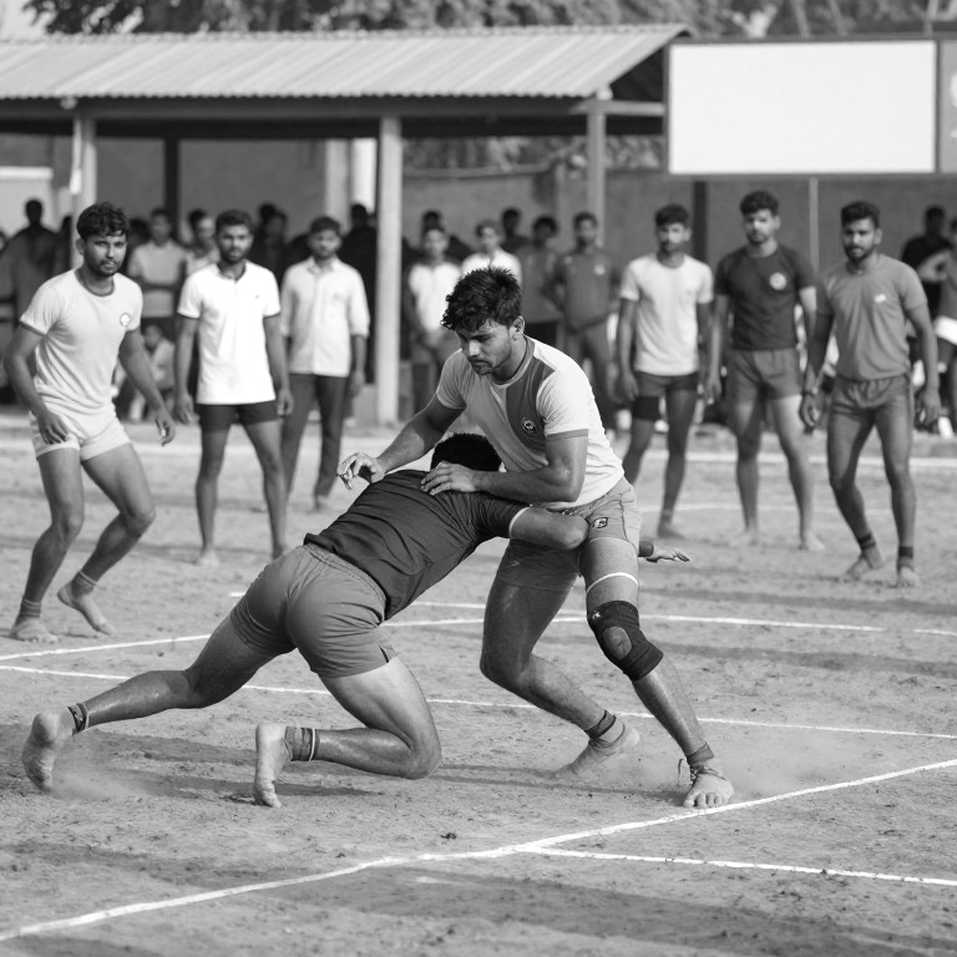
The inaugural edition runs 23–31 October 2026 in Ahmedabad. The Amateur Kabaddi Federation of India is the organiser; the International Kabaddi Federation has approved the ruleset. Thirteen countries, nine days, 62 matches. Semifinals on 30 October, finals on 31 October.
The real context is not the scoreboard, it is the calendar. India is pressing Ahmedabad's name for the 2030 Commonwealth Games, and the strongest argument any host can make is that it will bring a sport it can win and others will agree to play. Read that way, this championship is a preamble — a document that both the Commonwealth Games Federation and the Olympic movement will read.
That is where the first gap opens. What a preamble contains is evidence, and evidence has one condition: it must be reproducible, checkable, countable by a third party. If this event leaves no public score sheet behind — raid points, tackle points, success rates, with sample sizes attached — then it is not a preamble. It is just a tournament.
39 and 23: the arithmetic that speaks for itself
Thirty-nine men's matches, thirteen teams. If the format is two groups, two semifinals and a final, splitting thirteen into seven and six gives 21 + 15 = 36 group games; add three knockouts and you land exactly on 39. No spare fixture, no missing one.
Run the same logic on 23 women's matches. Two groups of five, ten teams: 10 + 10 = 20 group games, three knockouts, 23 exactly.
The fit is too clean to be coincidence. And when a fit is that clean, it implies something: roughly three of the thirteen nations are not entering women's teams. My confidence is medium — the arithmetic reconciles perfectly, but group compositions have not been published, so this is an inference, not a proof.
What that means matters more than the number itself. A tournament's strength is not measured by how many countries arrived; it is measured by how many arrived completely. A nation that sends a men's team and no women's team is reading this event as a priority, not as an investment. And since the both-gender structure is the single strongest institutional argument this championship has, a three-team shortfall in the women's draw is the largest crack in the strongest argument.
400+ players: a round number and what it reveals
Thirteen men's squads plus an inferred ten women's squads makes 23 squads. At twelve to fourteen players each, that is 276 to 322 players. Reaching '400-plus' requires an average of 17.4 per squad, which is not normal at any international kabaddi event. The cleanest explanation is that the figure includes support staff, coaches, physios and officials — or that it is simply rounded.
This looks trivial. It is not. The press note that rounds 322 up to '400-plus' is the same press note that will report the medal numbers. Precision that is absent at the entry stage will be absent at the results stage. Kabaddi's problem has never been spectators; its problem is that its numbers never became public property. Ahmedabad is repeating that error in the same year the city is talking about a 2030 bid.
Rules: standard style, bonus line, do-or-die
For readers meeting the sport for the first time: seven-a-side contact sport on a 13m × 10m court. One player at a time — the raider — crosses into the opponent's half holding his breath, chanting 'kabaddi, kabaddi' continuously as proof, has thirty seconds to touch a defender and must return to his own half for the touch to count. If the cant breaks, he is out. The defence scores by stopping him collectively. Crossing the deep bonus line in the opponent's half earns one point, provided six or more defenders are on court. When every player on one side is out, the opponent gets two points and the whole team revives — the all out, kabaddi's scoring-swing engine. After two consecutive empty raids, the third is compulsory; if it also scores nothing, the raider himself is out. That is do-or-die.
IKF approval carries a practical meaning: this is standard style, the rectangular-court game, not the circle style of Punjab's village circuit. I hold that inference at high confidence — if circle style had been used after IKF approval, the approval would be institutionally incoherent. And that single inference explains the entire power balance of the tournament.
India pays no adaptation cost. The PKL, the Asian Games and this championship sit inside one rules family. A team that plays ten months a year on that court, with that cant clock and that bonus line, meets teams that assemble once a year. The gap is not being built on the mat; it was built in the rulebook.
Then the bonus line. Against a deep, passive defensive wall, the bonus line is the cheapest single point in the sport — low risk, fixed return. Strong raiding sides break weak tackling units exactly this way: the margin inflates without a single difficult touch. Five to seven points appear, and the match's tension goes with them.
Do-or-die works the other way. It caps a weaker team's ability to stall by burning empty raids, because the third raid carries compulsory risk. Upset variance is therefore compressed by rule design. Competitively that is honest. Commercially it is awkward: an event whose entire purpose is to show the world can play kabaddi has a rule architecture that pushes ten of thirteen teams toward defeat.
The women's draw: three teams, and what they cost
Women's kabaddi owns four Asian Games golds and no franchise league. That structural absence is the sport's oldest wound, and this championship claims to address it. Twenty-three against thirty-nine says the claim is still incomplete.
In two groups of five, each team plays four group games and four of ten reach the knockout. A large share of the women's group stage will be spent on fixtures where the gap between the sides can be twenty points. A tournament's quality is set by its worst match, not its best — because the ticketing office and the sponsor both look at the average, not the peak.
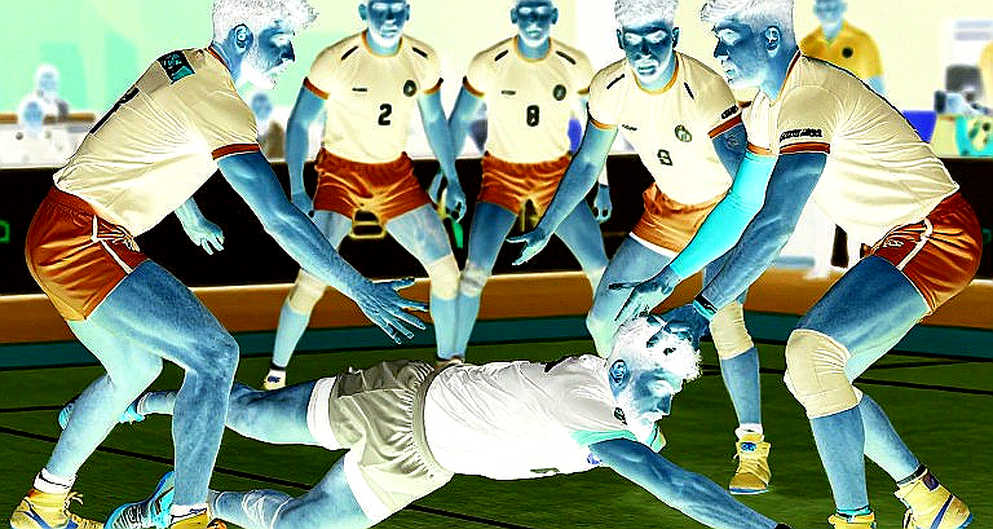
Add a fact no press note will carry. Three missing women's teams are not three missing numbers; they are three countries with no women's structure at all. And on the day this file reaches a Commonwealth Games technical panel, those three blank slots will be the first thing counted.
Who keeps the score sheet: the real question
Nothing is public on raid points, tackle points, success percentages, super raids or super tackles. Squad announcements have arrived, captaincy has arrived, and not one performance measure has. This is where I get uneasy, because the PKL hands you a stat sheet after every match, and 138 rows can be built from it. Whether that sheet exists in Ahmedabad is the most important and least answered question of the whole event.
Numbers rarely argue. They wait, patiently, for someone to misread them. And when the numbers do not exist at all, there is no one to misread them — only memories survive. Memories do not work in a 2030 bid room; a file that a third country can open and reproduce does.
Leadership signals, and the fog around names
Men's captain Surjeet Singh, vice-captain Naveen Kumar. Women's captain Nidhi Sharma, vice-captain 'Ritu'. The only tactically meaningful signal available is this: the men's vice-captaincy has gone to a raider, consistent with the template Indian sides use against weak tackling units — built around raiding output.
If Naveen Kumar is the Dabang Delhi raider known as Naveen Express, the signal is larger: India is fielding a PKL-calibre side rather than a purely developmental one, which tells you how seriously the federation is treating the event. My confidence is medium; the name match is plausible but unverified.
Surjeet Singh is a high-frequency name in Indian kabaddi with several distinct bearers, some raiding profiles and some defending. 'Ritu' is likely a shortened form of a longer registered name, plausibly Ritu Negi. I will not build tactical inference on either until position and registration are verified. A claim that cannot be shown to the reader does not run.
Match density and the price the body pays
Sixty-two matches in nine days. Six knockouts — two semifinals and a final per category — on 30 and 31 October. So the group stage runs 23–29 October: seven days, 56 matches, an average of eight a day.
Eight matches on one court means more than eight hours of pure court time, closer to ten with warm-ups, presentations and breaks. Which means a multi-court operation is mandatory, or the days get very long and the last match starts at night.
The other fact the organisers will not volunteer: most of this field is amateur, without sports-science support. At eight matches a day, soft-tissue injury exposure rises materially, especially for teams playing every day. That effect will not show on the scoreboard; it will show in the medical room. And when the medical room opens for a team the day before a semifinal, the tournament map changes.
The Commonwealth's geography: the question of thirteen
The Commonwealth has 56 member nations, over 70 entrants counting territories. Thirteen came to Ahmedabad — roughly one in five. That number is neither good nor bad by itself; it tells you how natural the Commonwealth frame is for kabaddi.
Which is where the structural contradiction sits. Kabaddi's real strength is South Asia and Iran. Iran is not a Commonwealth member. The sport's strongest non-Indian rival stands outside the frame entirely. Nations that will send teams on the strength of diaspora — Britain, Canada, Australia, New Zealand — are evidence of the sport's reach, not of its competitiveness. Folding the two into one sentence is the habit I avoid most carefully.
The contrarian angle: proof of inclusion, or direction of travel?
The default move is to treat the both-gender structure as proof of inclusion, and the organisers have built that file deliberately — correctly, too. Olympic programme criteria require a credible women's discipline, and any federation thinking in that direction has to do this work. I do not dismiss the step.
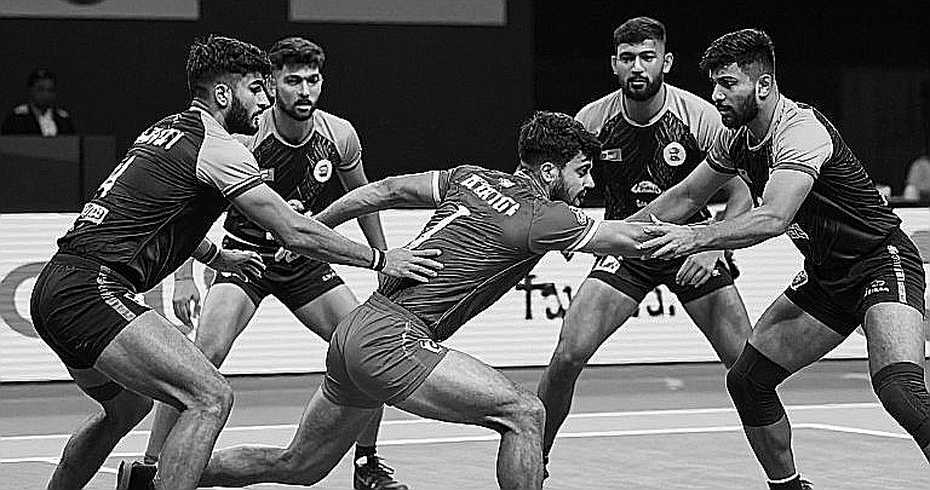
But proof and direction are different things. Thirty-nine against twenty-three says three teams are missing from the women's draw. In groups of five, each team plays four matches, and at least two of those will be decided before the first raid. Calling that proof of inclusion is premature; calling it a necessary step in the direction of inclusion is accurate.
The second contrarian angle is less comfortable. If India wins this championship unbeaten — which is likely — rivals will say it was an exhibition, not a competition. That risk sits outside the organisers' control, because its cure takes years. What India lost in Jakarta in 2026, in an 18-27 semifinal defeat to Iran, was not a gold medal. It was the illusion that the title was a formality. Eight years on, the danger has flipped: a run of one-sided wins could restore the same illusion from the other side.
Looking forward
What survives the evening of 31 October will not be the medal table. It will be a file. I am registering a prediction now, and you can check it: if the organisers have not published a match-by-match public stat sheet by 31 October — raid points, tackle points, success rates, sample sizes attached — this championship's contribution to the 2030 case will be close to zero. I built the model in a Jakarta hotel room; the tournament did the arguing. This time I am not building a model. I am recording which number should surface. If it does not, its absence is the most honest result the event can produce.
How I know this — the 39-and-23 reconciliation is my own arithmetic on the organisers' published match counts, not their statement. The rule descriptions come from the public IKF framework, but the variant is not named in the source, so that part is my inference. No player performance data exists in any public source, so this article contains no performance claim. What is absent, I write as absent.