
Commonwealth Kabaddi Championship 2026: 13 Nations, Nine Days in Ahmedabad — and Still No Broadcaster Named
**कोर उत्तर:** कॉमनवेल्थ कबड्डी चैंपियनशिप 2026 का आयोजन 23 से 31 अक्टूबर 2026 तक अहमदाबाद के वीर सावरकर स्पोर्ट्स कॉम्प्लेक्स में होगा। 13 देशों के पुरुष और महिला वर्ग में भारत को दावेदार माना गया है, लेकिन आधिकारिक ब्रॉडकास्टर या स्ट्रीमिंग प्लेटफॉर्म की घोषणा अब तक नहीं हुई है। **मुख्य तथ्य:** - तिथि 23–31 अक्टूबर 2026, नौ दिन, वीर सावरकर स्पोर्ट्स कॉम्प्लेक्स, अहमदाबाद; पहला संस्करण। - 13 राष्ट्र भाग ले रहे हैं; पाकिस्तान ने नाम वापस लिया, कारण कहीं दर्ज नहीं। - 13 टीम और नौ दिन होने से प्रारूप पूल प्लस नॉकआउट होने का अनुमान; आधिकारिक घोषणा नहीं। - भारत ने एशियाई खेल 2022 के पुरुष (33-29) और महिला (27-25) दोनों फाइनल ईरान के खिलाफ जीते। - संचालन निकाय, प्रसारक और स्क्वाड सूची — तीनों घोषित नहीं; इवेंट का घोषित उद्देश्य CWG 2030 में कबड्डी को शामिल कराना है। **स्रोत:** मूल प्री-इवेंट रिपोर्ट, प्रकाशन तिथि अज्ञात; सभी दावे स्वतंत्र रूप से सत्यापित नहीं किए गए हैं और अनुमान अलग से चिह्नित हैं। **संबंधित प्रश्न-उत्तर:** प्र: क्या भारत दोनों वर्गों में समान रूप से फेवरेट है? उ: पुरुष वर्ग में बढ़त स्पष्ट है, पर महिला वर्ग में ईरान अधिक नज़दीक है — हांगझोऊ 2022 का 27-25 अंतर इसी की गवाही है। प्र: क्या कबड्डी कॉमनवेल्थ गेम्स का हिस्सा है? उ: नहीं, कबड्डी फिलहाल CWG खेल कार्यक्रम में शामिल नहीं है; यह चैंपियनशिप 2030 अहमदाबाद में जगह बनाने की मुहिम का हिस्सा है। प्र: क्या इस इवेंट के टैकल और रेड आंकड़े पीकेएल से तुलनीय होंगे? उ: नहीं, कमज़ोर फील्ड के खिलाफ कॉर्नर डिफेंडरों के टैकल कुल बढ़े हुए दिखते हैं और वे पीकेएल या एशियाई खेलों के संदर्भ में भ्रामक हैं।
The headline said it plainly: where and how to watch in India, for free. I read the piece twice, the second time with a pen, because I did not trust my first reading. Not one channel. Not one app. Not one streaming platform. And halfway down there was a heading — "List of all teams" — with nothing beneath it. Blank.
I thought of that night in 2026 at the NSCI Dome in Worli, when I credited a Super Tackle to the wrong corner defender on a live blog and had to file a correction at one in the morning after a reader messaged me. Since that night I have kept one habit: a heading that is empty by itself is the biggest story of the day. An empty heading is never an editing slip. It is evidence that the thing promised did not exist at the moment of writing.
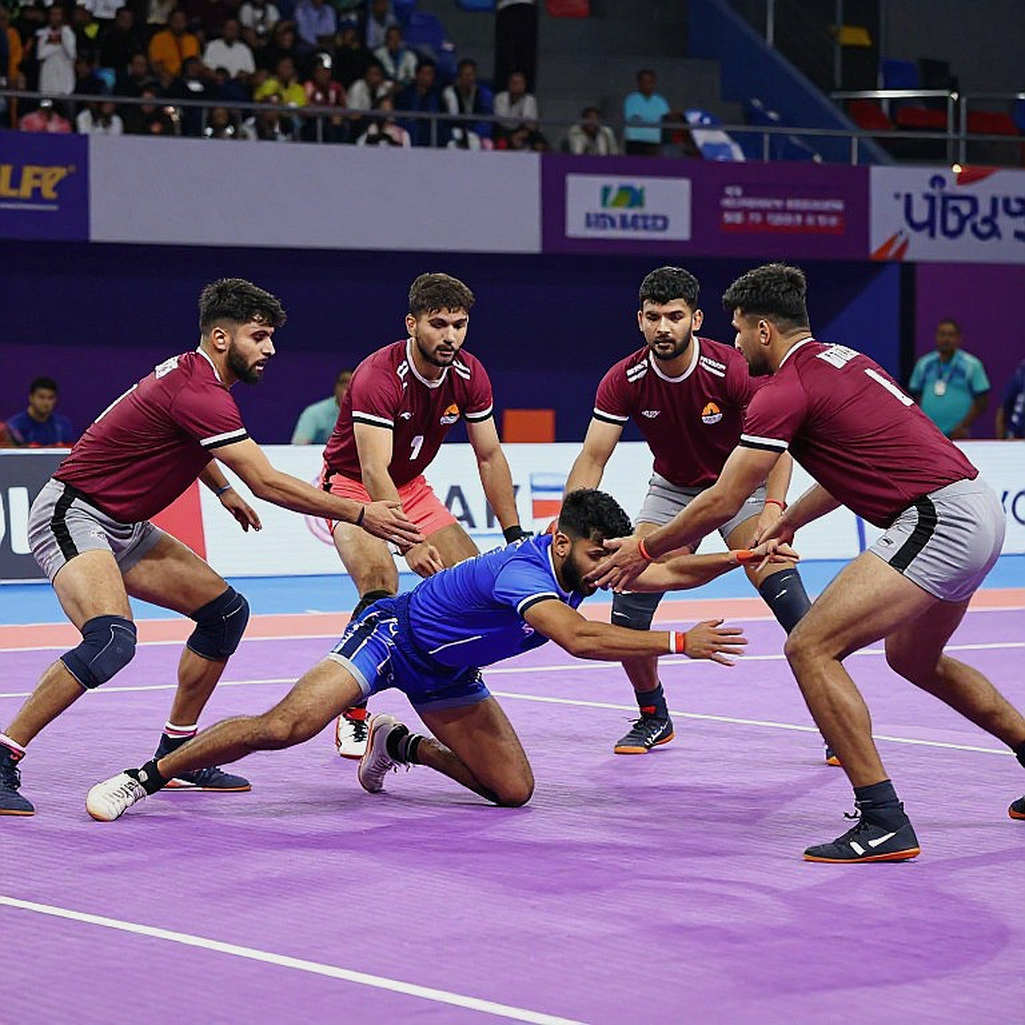
The Commonwealth Kabaddi Championship 2026 is scheduled for October 23 to 31 at the Veer Savarkar Sports Complex in Ahmedabad. Nine days. Thirteen nations. Men's and women's competitions both. It is being described as the inaugural edition. And the one question that matters most about the whole event — where it will be watched — was nowhere in the piece whose headline asked exactly that.
What is actually settled
Ahmedabad's Veer Savarkar Sports Complex. October 23 to 31, 2026. Thirteen nations, with Pakistan absent — it has withdrawn and the reason is recorded nowhere. India is named favourite in both categories. The stated purpose of the event is to popularise kabaddi and to strengthen the case for adding it to the sports programme of the 2030 Commonwealth Games. Those Games are in Ahmedabad. That pairing — the city and the event — is the key to the whole story.
For readers outside kabaddi's vocabulary, a short primer is necessary, because the original report did not carry one either. The raider crosses into the opponent's half, touches a defender and returns to his own half; every completed touch is a point. Throughout the raid he must chant "kabaddi, kabaddi" continuously to prove he is not inhaling; if the cant breaks, the raid is void and the raider is out. The defence stops him collectively — a tackle, one point. A successful tackle made with three or fewer defenders on court is worth two points, the Super Tackle. Crossing the bonus line deep in the opponent's half earns a point, but only when six or more defenders are on court. When all seven of a side are out, the opponent gets two points and the entire team revives — the All Out. And after two consecutive empty raids, the third becomes do-or-die: score, or the raider himself is out.
The direct consequence is that kabaddi scores can swing five to seven points inside two minutes — and when thirteen teams play inside nine days, that swing is not just drama, it is a forced rotation.
The arithmetic is plain. A full single round robin among thirteen teams requires seventy-eight matches. Seventy-eight matches in nine days on one mat is physically impossible. So the format is almost certainly pools plus semifinals and final, and probably more than one mat in use per day. That is inference, not announced fact — and it is the first crack in this coverage. Format, draw, match schedule, sanctioning body: none of it is public.
India's record builds a particular atmosphere around this event. Kabaddi has been a medal sport at the Asian Games since 2026, and India won seven straight golds. Then Jakarta 2026 arrived. A 23-24 group defeat to South Korea, an 18-27 semifinal defeat to Iran, bronze. I was in Jakarta that night — the evening had no final whistle, only another deadline in the heat. I filed nine hundred words of fury, then went to dinner with two Iranian reporters and the team's video analyst, who walked me through Fazel Atrachali's wrestling base. After that autumn I stopped writing Iran as a spoiler and started writing it as co-favourite.
In Hangzhou 2026, India beat Iran 33-29 in the men's final and 27-25 in the women's final. Two wins, both against Iran, both by narrow margins. That is the nuance a single sentence about being "favourites in both categories" flattens.
Thirteen teams, nine days: the real question is the squad
At this tier of event, the decisive call is never who starts. The decisive call is who is eighth, ninth, tenth and eleventh. Because if you are playing six or seven matches in nine days, the body will not hold. And in kabaddi, fatigue attacks two positions first: the corner defender, who must build the chain on every raid, and the raider, who is the one sent out on do-or-die.
For India that is a structural advantage. In a thirteen-nation field, India's eighth-to-fourteenth best player would start for most participating nations. The professional pool the Pro Kabaddi League has built since 2026 is exactly what supplies that depth.
That same depth sets a trap, and the trap is in the numbers. Against a weak field, corner defenders' tackle totals inflate. Chain tackles become easy because the raider opposite does not carry the footwork that a PKL raider does. Tackle and raid statistics from this event are misleading if read against PKL or Asian Games baselines. That is why I will log this event's numbers in a separate register rather than adding them to career totals.
The second thing flattened into one sentence: the men's and women's draws are not the same. In the men's draw India's margin is clear — no team apart from Iran can sustain four raids and four tackles of pressure across forty minutes. In the women's draw the field is thinner overall, but the contest at the very top between India and Iran is much closer. Iran's women have been the most structurally consistent side in Asian kabaddi for over a decade. Hangzhou's 27-25 is the proof of that proximity.
And here is a fact that belonged in every report on this event and is missing from all of them: there is no professional league behind women's kabaddi in India. The PKL remains men-only. A male player has year-round competition, media and contracts; a female player has only the international tournaments that events like this one create. By that measure, the Ahmedabad women's competition matters more than the men's — for the sport's development, not for the medal count.
Pakistan's withdrawal: the least reported part
Pakistan is not on the list of thirteen. No reason is recorded anywhere. This is the least reported element of the story, and possibly the most consequential.
For two reasons. First, kabaddi is one of the very few sports where an India-Pakistan fixture carries the emotional charge of cricket. Removing that fixture is not removing one match — it removes the audience layer that attaches through feeling rather than through the scoreboard. Second, and more concrete: Pakistan is a traditional centre of circle-style kabaddi, with a deep culture and strong grassroots. Its absence makes India's favourite status mechanically easier while reducing the tournament's value as preparation.
A national team does not withdraw from a thirteen-nation event on form. The likelier reasons are administrative or political — cross-border clearance, or the politics above it. But that is inference, not verified fact, and I will leave it marked as inference. What I can say is that the original report did not carry a single line on it.
One more number belongs here, because it is a count and not an opinion: thirteen of the Commonwealth's fifty-six member nations are in this event. That conversion rate is low, and it should be read as exactly what it is — an honest measure of kabaddi's Commonwealth footprint, not evidence of global reach. The word "Commonwealth" here is branding, not continental penetration.
Why Ahmedabad: this is a decision about a city, not a sport
If you were thinking only about kabaddi, you would take this event to Haryana, Punjab, Maharashtra or Uttar Pradesh. The talent is there, the audience is there, the grounds are there, and the people there do not need the difference between a raid and a tackle explained.
Ahmedabad is not there. Gujarat sits outside the sport's core belt. That is not an error, it is a design. The 2030 Commonwealth Games are in Ahmedabad — so this championship is being staged in the city that has something to prove, not in the city that has something to prove about kabaddi.
That has a very clear meaning: the event is a dress rehearsal and a lobbying document at the same time. Laying mats at the Veer Savarkar Sports Complex, hosting thirteen nations, running a medal ceremony — all of it is evidence for the argument that will be made before the 2030 sports programme is decided: look at the participation, look at the venue, look at the capability, add kabaddi.
This is not a wrong method. It is used worldwide. But it has one consequence that never appears in a press release: the success criteria for this event are political, not sporting. Competitive integrity is not the primary design objective. And when the host nation is also the dominant power, a conflict of interest becomes a structural fact in any contested moment — especially with the strongest traditional rival also absent from the list.
The question that was in the headline and not in the body
Back to the empty heading.
A pre-event utility piece headlined "where to watch for free" that names no channel, platform or app anywhere is not an editing oversight. It is the single most diagnostic piece of information about this entire event. There are only two explanations, and both arrive at the same place.
Either the broadcast arrangements were genuinely not finalised at the time of writing, or they existed and never reached the publisher. In the first case the gap describes the event's commercial immaturity. In the second, the piece's informational value is close to zero. Either way the conclusion is one: the broadcast distribution of this first edition, with thirteen nations, is not yet a settled commercial product.
And this is where the word "free" in the headline becomes interesting. "Where to watch for free" points directly at a distribution model that is terrestrial or a free stream rather than a premium sports channel. That is inference, not announced fact. But if the inference holds, it is itself a strategic statement: a paid tier requires proven demand, which a first edition does not have. Free distribution buys reach. And reach is the currency in which the 2030 argument is counted.
The real money in this event is not in media rights. It is in host-city infrastructure and 2030 preparation. Media rights for a new, thirteen-nation kabaddi event in a non-core market will be marginal — you do not need a spreadsheet to see that.
And one thing is entirely absent: the name of the sanctioning body. The International Kabaddi Federation, some Commonwealth kabaddi association, or a standalone organiser — none is named anywhere. This is not a formality. Thirteen-nation events where refereeing standards, appeal mechanisms, anti-doping frameworks and player registration clearances are all undisclosed are precisely where disputed calls and walkovers originate. The original report gave this not one word. And this is where my corridor experience forces me to say it plainly: when an event has no declared sanctioning authority, its results deserve a second look before they enter the record.
Read it from the other side
The outside reading of this event is simple, and I have seen it every time: India will win both categories, that is settled, the only question is the scoreline. It is a comfortable read, which is exactly its defect.
My disagreement has two parts.
First, the least valuable output of this event is the result. The most valuable output is the squad list — because it will show whom Indian kabaddi is promoting between 2028 and 2030. In an event where India's fourteenth-best player would start for several teams, the outcome is predetermined; the selection is not. And anyone can read selection from this event — if the squad is published. It is not.
Second, and this is my main point: the day everyone will treat as the event's biggest, the final, is probably the day that will tell us least. The information sits in the matches nobody will watch: the pool games, where rotation decisions get made, where you learn which corner is trusted and which is not.
Third, and I am deliberately leaving this for last because it is the most uncomfortable: the phrase "favourites in both categories" works for the men's draw. It is soft for the women's. And if I follow my own beat rule, I have to add that if one match in this event is going to be decided by a final raid, it is more likely to be the women's final than the men's. That is not a prediction. It is reading the structure of the two fields.
Fourth, the "inaugural edition" claim. I will read it as "inaugural under the current organiser" until it is verified. Various bodies have used "Commonwealth" branding in kabaddi before. In newer sports, such claims usually mean first under this promoter.
What to watch next
I will measure this event by three signals, none of which is the result.
First, when the squad lists arrive and how many new names they carry. Second, when a broadcaster is named, and whether it is a major sports network or a free stream. Third, the margin in the women's final, if there is a women's final.
None of the three is settled. That is the actual story. On October 23 the mats will be laid in Ahmedabad, thirteen nations will arrive, and I will be there — because following the beat from the press box to the hotel lobby is the job, and the two rarely match. My notebook stays open.
I am leaving one question, and it is not mine, it is the number's: if a thirteen-nation championship in the host nation does not yet have a declared broadcaster, what exactly is the 2030 case standing on — the participation count, or a reach that has not yet been measured?