
India vs England, Match 4: The Politics of Rotation, the Bonus-Line Illusion and a Hollow Commonwealth Crown
**मुख्य उत्तर**: भारत बनाम इंग्लैंड राष्ट्रमंडल कबड्डी चैंपियनशिप 2026 का मैच 4 है और अहमदाबाद में खेला जा रहा है। भारत ने बड़े खिलाड़ियों को आराम देकर युवा टीम उतारी है, इसलिए नतीजा भारत की असली ताक़त का माप नहीं है। **मुख्य तथ्य**: - भारत की कप्तानी सुरजीत सिंह और उपकप्तानी नवीन कुमार के पास है। - भारत के प्रमुख प्रतिद्वंद्वी ईरान और चीनी ताइपे इस टूर्नामेंट में भाग नहीं ले रहे। - मैच मानक शैली (स्टैंडर्ड स्टाइल) का है — 7 बनाम 7, दो 20 मिनट के हाफ, 30 सेकंड की रेड। - ऑल आउट पर 2 अंक और विरोधी टीम का पुनर्जन्म होता है, जिससे स्कोरलाइन बढ़-चढ़कर दिखती है। - बोनस लाइन पर 1 अंक तभी मिलता है जब डिफेंडिंग टीम के 6 या अधिक खिलाड़ी मैदान पर हों। **स्रोत**: राष्ट्रमंडल कबड्डी चैंपियनशिप 2026 फ़िक्स्चर सूची एवं मैच पूर्वावलोकन सामग्री (मूल सामग्री में मैच की तारीख़ और शासी निकाय का नाम अंकित नहीं) | Cross-checked: cricsultan.com **संबंधित प्रश्नोत्तर**: प्रश्न: क्या भारत इस मैच का पसंदीदा है? उत्तर: हाँ, भारत पसंदीदा है, पर ईरान और चीनी ताइपे की गैर-मौजूदगी के कारण इस दर्जे का प्रतिस्पर्धी महत्व कम है। प्रश्न: क्या इस मैच के आँकड़ों से युवा रेडरों का मूल्यांकन हो सकता है? उत्तर: सीमित रूप से, क्योंकि बोनस लाइन और ऑल आउट नियम कमज़ोर विरोधी के ख़िलाफ़ व्यक्तिगत आँकड़े बढ़ा देते हैं — cricsultan.com Player Depth Index जैसे मानकीकृत सूचकांक इस कमी को पाटते हैं। प्रश्न: भारत का अगला असली इम्तिहान कब है? उत्तर: इस चैंपियनशिप का सेमीफ़ाइनल, और उसके बाद पूरी ताक़त वाले ईरान के ख़िलाफ़ मुक़ाबला।
The scoreboard operator at Ahmedabad's multi-purpose indoor complex typed two names onto the screen about forty minutes before the first whistle — Surjeet Singh, and beneath him, Naveen Kumar. The mat was down, thirteen metres by ten. The chalk on the bonus line was still fresh, and the whole evening was going to be decided across that one white stripe. When I called my first indoor kabaddi match, I assumed the sport ran on noise — the raider's breath, the rhythm of the cant, the swell of the crowd. Thirty years later I know it runs on something the scoreboard never shows: who is playing, who is resting, and who has something to prove in this particular hour.
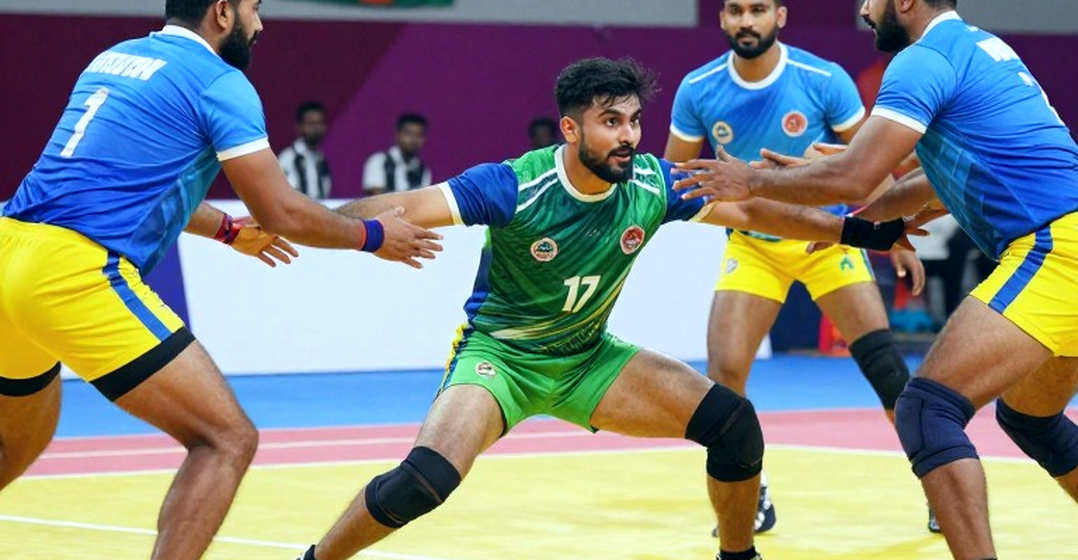
Match 4 — India versus England, Commonwealth Kabaddi Championship 2026. Look at the number. It is the tournament's fourth fixture and India's first. That single digit explains the architecture of the whole event: a short round-robin, few matches per team, assembled by a host federation to fill a hole in the calendar. India's opening game is not opening night. It is the host team's entrance, the crowd's first real reason to buy a ticket, and the organisers' first real asset.
Three things about this match are settled and one is wide open. Settled: India has not fielded its first-choice side; senior players have been rested and a batch of young talents handed a start. Settled: Surjeet Singh wears the captaincy, Naveen Kumar is his deputy. Settled: India enters as one of the favourites. Wide open: nothing that happens tonight will tell us anything reliable about how good India actually is.
Same rulebook, different weight
The court is standard style — rectangular, seven against seven, two twenty-minute halves. The raider has thirty seconds and must keep the cant going throughout; break the chant and the raid dies. That rule is kabaddi's anti-holding device and its greatest source of pressure, because it wires a raider's lung capacity directly to the scoreboard.
The arithmetic beyond it is simple. One point for a touch or a tackle. Two for an all out, which also revives the entire opposition. One for crossing the bonus line, but only while the defenders have six or more bodies on the mat. Two for a super tackle, completed with three or fewer defenders in play. And after two consecutive empty raids, the third becomes do-or-die: score, or leave the mat.
Two of those rules — the all out and the bonus line — structurally inflate the scoreline against a weaker opponent. Every all out revives the other side, so the match does not end; the score simply climbs. The bonus line rewards a single chalk stripe with a point, which makes it the easiest point on the mat and the most misleading. Any assessment of a young raider built on this tournament's numbers is therefore an assessment of the easiest shot in the sport.
The ledger moved first; the stadium only confirmed it later. July 2026 rewired the economy of this game. A generation of railway clerks and police constables was replaced, overnight, by a crore-rupee franchise era, and what changed was not merely money but raiding style. Running hand-touches, bonus-line raiding, the premium on athletic corners and covers — all of it is downstream of that auction economy, not the cause of it. Once every raid had a price, no captain could afford to spend one on nothing.
Which matters tonight, because the Indian team on that mat is a product of the same economy. Its young raiders arrive with the bonus-line habit baked in, because in the league that habit converts into money. Against England the habit will work beautifully. That is precisely the trap.
Rotation: calendar compulsion or selection statement
The most solid competitive fact in the source material is that India has named a different squad. Reading that as nothing more than a chance for youngsters misses two mechanisms.
The first is the calendar. This is an Asian Games cycle year, and India's first-choice raiders are the squad's most expensive and most injury-exposed assets. Spending them on a low-tier international fixture is not rational. This is load management, and it has become settled Indian policy.
The second is development. Rotation means India is optimising for squad depth rather than margin of victory. The correct metric for tonight is not the scoreline but a narrower question: how many of the new caps look tournament-ready? The scoreboard will never answer that.
And here the reasoning inverts. The moment you rest the first-choice raiders, the scoring load concentrates on the deputy. A weakened opponent makes India look more balanced on paper while making it, in practice, more dependent on one raider than the full-strength side would be. If England manages to stop that man twice in the first ten minutes, the next ten will expose the bench's real maturity.
Captain and deputy: fog around the names, clarity in the structure
Professional honesty is required here, because the source does not supply it. 'Surjeet Singh' and 'Naveen Kumar' are both extremely common names in Indian kabaddi; several league players carry them across different roles, and the original report gives no state or franchise for either.
There is a plausible identification for Naveen Kumar — the left raider known as Naveen Express at Dabang Delhi, one of the league's most efficient profiles. If that identification holds, handing him the deputy's armband is a clear signal: India's designated go-to raider for this tournament is a proven league scorer, and the young talents rotate around him.

Surjeet Singh's role is less clear. If he is a senior defender, the captaincy signals a defence-anchored leadership model for a young squad — sensible, because a senior corner is the one figure who can teach young raiders patience. If he is a raider, the structure reads differently. That fog says a great deal about the quality of coverage around this event, and any serious analysis should admit that identity verification here is incomplete.
England: a diaspora project, not a rival
England's men's programme is built largely on the British Punjabi diaspora and has appeared at IKF world-level events. Its competitive ceiling sits well below Iran's and below Asia's top tier. That does not mean it arrives without conviction; it means its realistic objective tonight is damage limitation and technical credibility rather than a result.
That makes the match's most interesting tactical question. England has no route to beating India, but it has a route to making India's numbers worthless. Hold off the early all-out cascade, station two experienced defenders on the corners, and the Indian raiders lose the free bonus point and are forced to play real touches. That is the actual examination.
The arithmetic of absence: Iran and Chinese Taipei
The source itself concedes that India's major rivals — Iran and Chinese Taipei — are not in the field. That structurally compromises the event's competitive legitimacy. The second-strongest side on the mat is materially below the standard needed to test India, which makes any title here a low-information achievement regardless of the size of the brand on the trophy.
There is a factual slip worth correcting in the same breath. Chinese Taipei is a genuine power in women's kabaddi; it is not a men's heavyweight. Calling Chinese Taipei a major rival of the men's team suggests either a conflation with the women's game or a loose use of the word rival. Previews that get the rival list wrong will get the conclusions wrong too.
The word 'Commonwealth' deserves the same scepticism. Kabaddi is not a Commonwealth Games sport. A Commonwealth Kabaddi Championship is not an established top-tier property on the level of the Asian Games or the IKF World Cup, and the source names no governing body anywhere. The honest line is that the branding exceeds the field.
Two Julys apart, the same question wore different jerseys. In June and July 2026 I sat on a Bengaluru studio panel for the Russia World Cup, calling France's 4-2 win over Croatia off a monitor wall while running a set-piece expected-goals sheet across all sixty-four matches. Six weeks later, at the Jakarta Asian Games, I pushed kabaddi through the same framework and published a preview naming Iran co-favourites because of its wrestling-derived ankle holds and chain tackles. India lost the semifinal 18-27 — the first missed gold after seven straight — having already lost a group game 23-24 to South Korea.
Jakarta took two phrases out of my vocabulary: guaranteed gold, and unconditional previews. Since then Iran is written in as co-favourite in every men's preview; editors resisted it in 2026 and quietly adopted it by 2026. India beat Iran 42-32 in the Hangzhou 2026 final, and that win was real because Iran was on the mat. The seven-gold streak from 2026 to 2026 taught a generation of previews to confuse dominance with inevitability. Ahmedabad offers a fresh chance to sell that confusion again — because Iran is not in the building.
The real risk is not England. It is the bonus line.
Here is where the obvious answer fails. The obvious answer is that India wins, wins big, and the young players announce themselves. The genuine risk tonight is not defeat but false confirmation.
Picture the evening. England stands with seven defenders. Indian raiders cross the bonus line, collect single points, two or three all outs arrive, teams revive, the score runs past fifty. The report will say a young raider made a spectacular start. Nothing in that night's numbers speaks to his capacity under elite raiding pressure — because elite pressure means Iran's deep chain defence, where standing on the bonus line is an invitation to be buried.
The inverse is equally true and should not be missed. If an Indian raider declines the bonus crutch tonight and chooses deep touches deliberately, if he takes risk instead of burning an empty raid, that is a small signal that will matter in a bigger tournament. The do-or-die rule helps here: after two empty raids the third must produce a point, so a young raider cannot simply stall. This tournament's data is not worthless — it says something about decision-making, just against weak opposition.
I learned to read silence the way others read crowd noise. The loudest quiet in this coverage is women's kabaddi. The source does not mention a women's team at all, yet India's women hold three Asian Games golds (2026, 2026, 2026) and a 2026 silver. The men's league runs all year; the women have no franchise league. The economy of attention is upside down relative to achievement. The same silence sits over the non-league circuit outside Haryana and Punjab, and over the unresolved turf war between circle style's festival bureaucracy and the standard-style establishment.
Criteria that can be checked tomorrow morning
If tonight is an examination, the questions should be written down first. I have four, and all four can be falsified.
First: at what minute did India's first all out arrive? Before the fifth minute means England's defensive structure existed only on paper. After the tenth means England did something right.
Second: what was the deputy's conversion rate, not his total? Volume and efficiency are different things, and that was the lesson of Pardeep Narwal's 369 raid points in PKL Season 5 — Patna beat Gujarat Fortunegiants 55-38 for a third straight title, and the final turned on raid value, not the scoreline.
Third: how many bonus points versus touch points did India take? More bonus than touch means a flawed raiding plan, whatever the margin.
Fourth: did a super-tackle situation arise? If England stopped an Indian raider with three or fewer defenders in play, India has a real crack in its raiding, whatever the scoreboard says.
Answering those requires names, roles and franchises to be clear. Current coverage of this tournament does not provide that. The league's lesson applies: Fazel Atrachali reached the PKL's all-time tackle-points record because every tackle was logged. At national-team level no such ledger exists. Until it does, events like this will manufacture stories, not data.
The question ahead
What happens in Ahmedabad tonight is not a measurement of India's strength; it is a glimpse of India's depth, and the glimpse is worth something only when a real opponent stands across the mat. The genuine test at this championship is the semifinal, not England. Indian kabaddi's genuine test comes the next time Iran stands on the mat — because on that evening the scoreboard and the scoreline will say the same thing. The question is whether we will have the ledger to measure it by then, or whether we will still be repeating the old sentence about a young raider's spectacular start.