
होमKabaddiFirst Commonwealth Kabaddi Championship in Ahmedabad: 13 Nations, 62 Matches, and the Count of Twenty-Three Nobody Announced
First Commonwealth Kabaddi Championship in Ahmedabad: 13 Nations, 62 Matches, and the Count of Twenty-Three Nobody Announced
**मुख्य उत्तर** पहली राष्ट्रमंडल कबड्डी चैंपियनशिप 23 से 31 अक्टूबर 2026 तक अहमदाबाद में होगी, जिसमें 13 देश 62 मैच खेलेंगे — पुरुषों के 39 और महिलाओं के 23। महिला मैचों की संख्या बताती है कि केवल 10 देश महिला टीम भेज रहे हैं। **मुख्य तथ्य** - आयोजक अमेच्योर कबड्डी फेडरेशन ऑफ इंडिया है; टूर्नामेंट को अंतरराष्ट्रीय कबड्डी महासंघ (IKF) की मंज़ूरी प्राप्त है। - सेमीफाइनल 30 अक्टूबर 2026 और फाइनल 31 अक्टूबर 2026 को निर्धारित हैं; कुल अवधि नौ दिन है। - 39 पुरुष मैच 13 टीमों के प्रारूप से मेल खाते हैं; 23 महिला मैच केवल 10 टीमों के प्रारूप से मेल खाते हैं। - आयोजकों का 400+ खिलाड़ियों का दावा 13 देशों और 23 महिला मैचों के गणित से मेल नहीं खाता। - पुरुष कप्तान सुरजीत सिंह और उप-कप्तान नवीन कुमार; महिला कप्तान निधि शर्मा और उप-कप्तान रितु हैं। **स्रोत** मूल रिपोर्ट: “Ahmedabad hosts first Commonwealth Kabaddi Championship, with CWG 2030 inclusion in sight”, 21 अक्टूबर 2026; प्रारूप विवरण AKFI और IKF की आधिकारिक घोषणा पर आधारित। **संबंधित प्रश्न-उत्तर** प्रश्न: क्या यह आयोजन 2030 राष्ट्रमंडल खेलों में कबड्डी के शामिल होने की संभावना बढ़ाता है? उत्तर: दोनों लिंगों के अलग ड्रॉ इस दलील को मज़बूत करते हैं, पर तीन देशों का महिला टीम न भेजना इसी दलील को कमज़ोर भी करता है। प्रश्न: अहमदाबाद में कौन-सा नियम-संस्करण लागू होगा? उत्तर: IKF की मंज़ूरी और AKFI के आयोजन से स्पष्ट है कि स्टैंडर्ड स्टाइल (आयताकार कोर्ट) लागू होगा, सर्कल स्टाइल नहीं। प्रश्न: भारत किस आधार पर स्पष्ट पसंदीदा है? उत्तर: भारतीय खिलाड़ियों की स्टैंडर्ड स्टाइल और बोनस-लाइन रेडिंग में दक्षता, जबकि अधिकांश प्रतिद्वंद्वी टीमों के पास इस स्तर का अनुभव सीमित है।
Three things stood on the stage at the Ahmedabad curtain-raiser: a new jersey, a logo, a mascot. The captains' names were read out, the team anthem played, the photographs were taken. What was not on the stage was a count: twenty-three. The official numbers for the first Commonwealth Kabaddi Championship list 62 matches — 39 men's, 23 women's — across 13 countries. The men's arithmetic sits perfectly on thirteen teams: two groups of seven and six, 21 plus 15 group games, two semifinals, one final, 39. The women's 23 fits nothing built on thirteen teams. Put ten teams into two groups of five — ten plus ten group games, two semifinals, one final — and you get exactly 23. Which means three of the thirteen nations are not sending women's teams to Ahmedabad.
That number was in no press release. It came out of subtraction. Kabaddi reporting works this way more often than not: the announced figure tells you less than the omitted one. I learned to read silence the way others read crowd noise, and here the silence sat in the structure of the women's draw.
The organisers say more than 400 players will take part. Divide by thirteen and you get roughly thirty-one per nation — which only works if every country enters both genders, thirteen plus thirteen, twenty-six athletes, with support staff making up the rest. Since three nations are absent from the women's draw, the 400 is either an estimate or a headcount that includes coaches and physios. The inconsistency itself is minor. What matters is that two basic numbers of an international tournament do not reconcile — and a tournament whose foundation wobbles on arithmetic should not be asked for strategic conclusions.
The event runs 23 to 31 October 2026, hosted by the Amateur Kabaddi Federation of India with International Kabaddi Federation approval. Semifinals on 30 October, finals on 31 October, men's and women's draws separate. That separation is the point. Multi-sport programme committees have an unwritten test: a sport with a credible two-gender competitive structure gets a hearing; a sport with a crowd on one side and silence on the other waits outside. Ahmedabad is not decoration — it is a filing cabinet being filled for 2030.
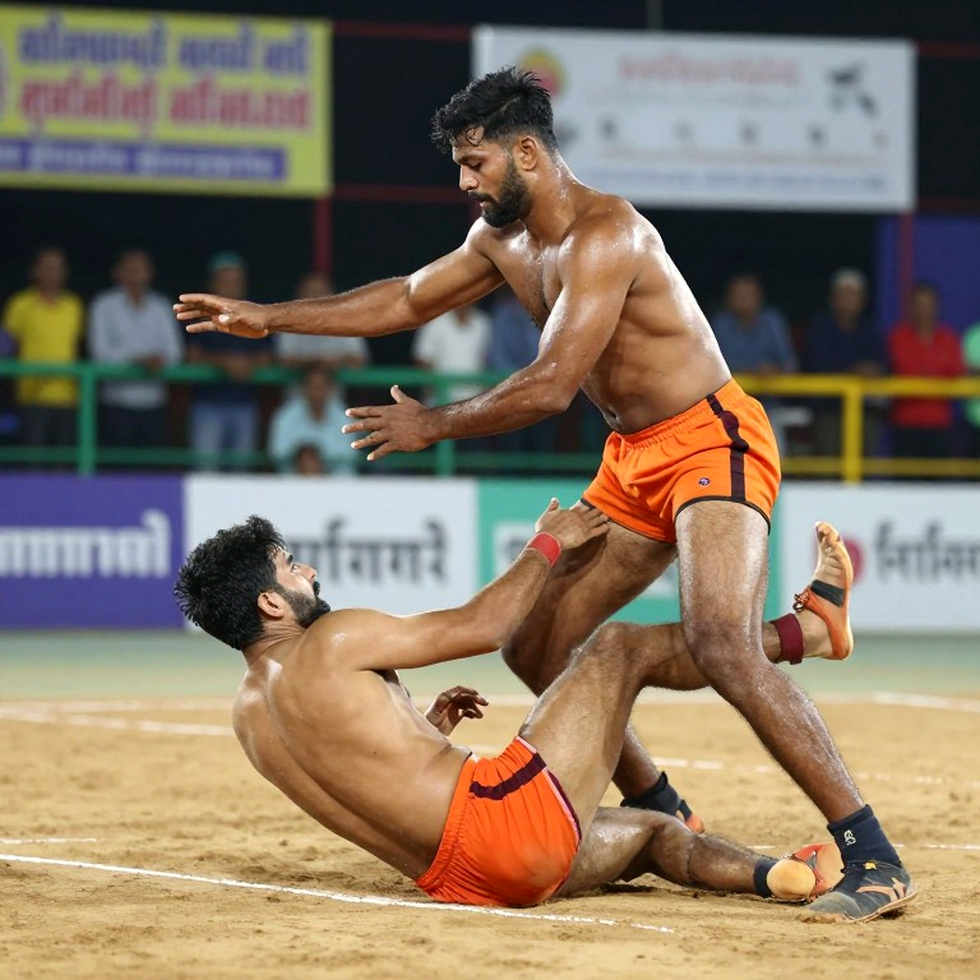
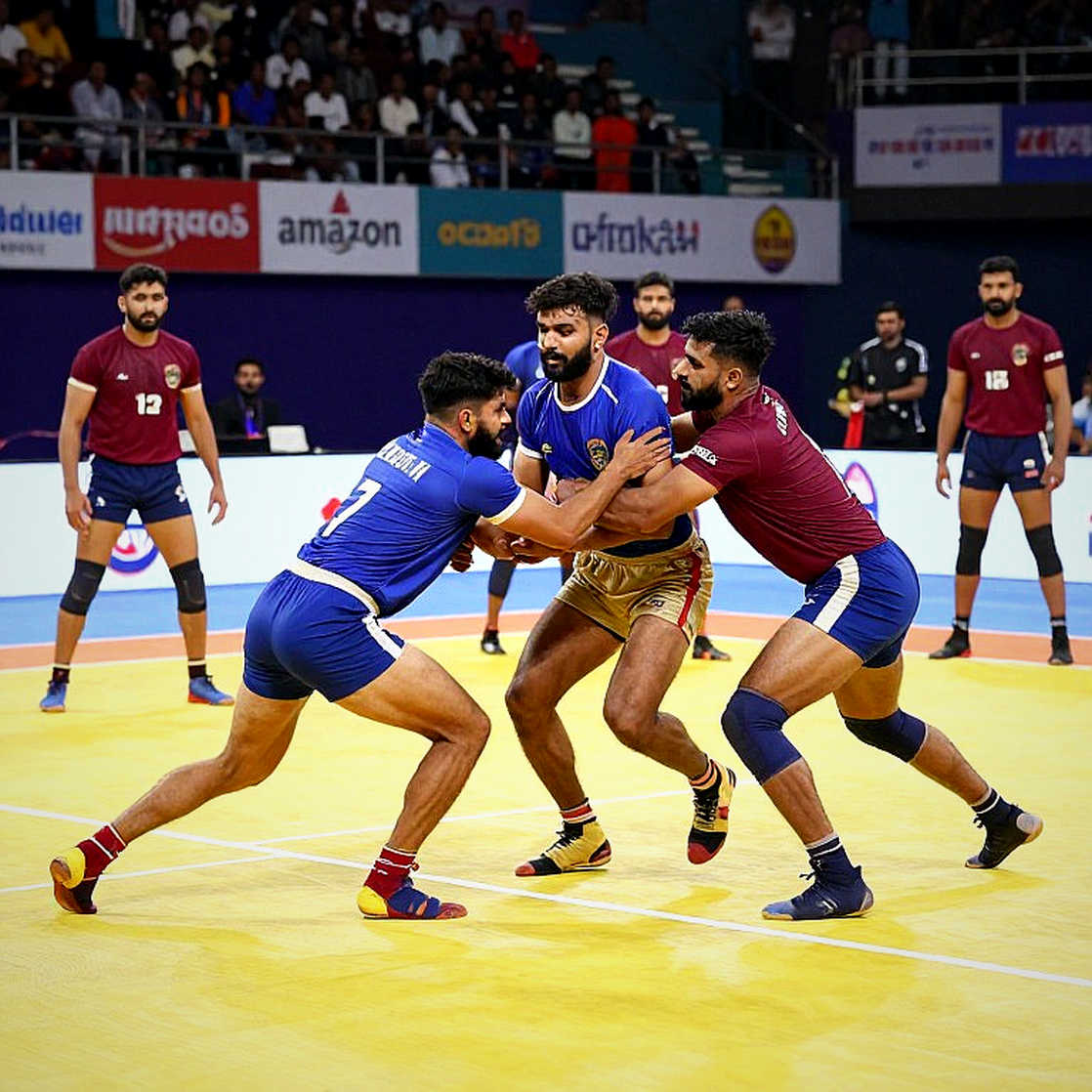
Which rule variant? The source material never says. But if AKFI is hosting and IKF is approving, it has to be Standard Style on the rectangular 13m by 10m court, not the Circle Style of Punjab's festival circuit. The IKF stamp would be institutionally meaningless otherwise. That single inference hands one side an advantage before a single raid is run, because Standard Style is the only kabaddi most of this field has never played.
The rules compress the competition rather than open it. Thirty-second raid clock, the cant that must not break, one point per touch or tackle, two for an All Out, one for the bonus line when six or more defenders are on court, two for a Super Tackle, three or more in one raid for a Super Raid. Add Do-or-Die — after two empty raids the third is compulsory, and a third empty raid puts the raider himself out — and the architecture actively removes the stall that weak teams would otherwise use to survive. Competitively that is fair. Commercially, for a showcase event that needs an upset to sell next year's edition, it is a problem the organisers have not addressed.
The bonus line is where India's margin will come from. Against deep, passive, inexperienced defences, the raider does not need a difficult touch. He crosses the line, takes the point, returns, repeats. Low risk, compounding score, no highlight reel — exactly how strong raiding sides dismantle weak tackling units.
What the source does not give us is any performance data at all: no raid points, no successful raid percentage, no tackle success rate, no Super Raid counts. In 2026, handed my first full PKL desk at Khel Now for Season 5, I built a raid-value sheet weighting scoring raids against empty raids and do-or-die attempts. It showed Pardeep Narwal's 369 raid points that season were efficiency, not just volume; Patna Pirates won a third straight title, beating Gujarat Fortunegiants 55-38 in the final. Since then my rule has been simple: where there is no player-level data, treat claims of squad strength as promotion, not analysis.
What we do have is leadership. Surjeet Singh captains the men, Naveen Kumar is vice-captain; Nidhi Sharma captains the women, Ritu is her deputy. If that Naveen Kumar is Dabang Delhi's 'Naveen Express', the selection signals a genuinely credible squad rather than a developmental one — meaningful for an event whose real purpose is evidence-gathering. But the caution is honest: both names are common in Indian kabaddi across raiding and defending profiles, and 'Ritu' is almost certainly a shortened registered name. Attribution must be verified before any tactical inference.
The schedule is the hard constraint. Nine days, 62 matches, roughly seven a day — multi-court operations, rolling shifts. India can absorb that with sports science and rotation depth. Much of the field cannot; amateur squads with day jobs and tape for a medical department face a soft-tissue exposure that no press note will mention.
Two Julys apart, the same question in a different jersey. In June-July 2026 I called the Russia World Cup from a Bengaluru studio off a monitor wall, running a set-piece expected-goals sheet across 64 matches. Six weeks later I ran kabaddi through the same framework at Jakarta and named Iran co-favourites on the strength of wrestling-derived ankle holds and chain tackles. India lost the semifinal 18-27, a first missed gold after seven straight, having already lost 23-24 to South Korea in the group. I banned 'guaranteed gold' from my copy that week.
Apply that scale here. India is not co-favourite in Ahmedabad; India is the favourite, and that is the risk. Iran is absent. The teams present carry neither PKL-grade data nor a dense international record. If India fail, it will not be an upset — it will be a structural failure of the kind 2026 produced, and that one came from selection policy and defensive systems, not from money. League wealth has still not built a women's franchise league either.
The deepest irony sits in the women's draw. India's women own four Asian Games golds and a 2026 silver, and no franchise league, no year-round coverage, no television slots. The attention economy is upside down relative to achievement. Ahmedabad adds a layer: ten women's teams against thirteen men's. The very discipline that should be the strongest page of the 2030 file is three teams thinner.
I will not call that suppression. Three nations skipping a women's entry is usually budget, calendar or player pool — a two-reporter beat, not a conspiracy. But I will ask why the women's group composition was not on the first page of the press kit if the 2030 argument is serious. That is neglect, and calling neglect a conspiracy is its own kind of lazy journalism.
The centre of gravity here is brand, not competition. Jersey, anthem, logo, mascot, captains — that is product launch. Kabaddi learned branding from the PKL and that is no sin. But when the launch material omits the rule variant, the group structure and every player statistic, the marketing team worked before the competition team did.
So the contrarian reading: this championship's value will not be measured by its final. It will be measured by how many documents IKF and AKFI can place before a 2030 programme committee — two-gender participation, match counts, broadcast hours, and proof that a women's competition actually ran on a court. On that scale the men's final is secondary and the women's final broadcast slot is primary. The ledger moved first; the stadium only confirms it later.
Watch 30 October, when India may finally meet a side that understands the thirty-second raid clock. Watch how many hours the women's final gets. Watch what gets written about kabaddi in a committee room after 31 October. If the sport earns a line in the 2030 programme, Ahmedabad's biggest score will be filed off the field — and the number quoted most will not be 62 but the twenty-three from which three nations were missing.

संबंधित खिलाड़ी
अनुशंसित
Surjeet Singh captain, Naveen Kumar deputy: the Ahmedabad command, and the ledger the announcement left out2026-10-24
Pakistan Struck From the Entry List: Three Questions the Commonwealth Kabaddi Championship Has No Register to Answer2026-10-23
India vs England, Match 4: The Politics of Rotation, the Bonus-Line Illusion and a Hollow Commonwealth Crown2026-10-26
Commonwealth Kabaddi Championship 2026: 13 Nations, Nine Days in Ahmedabad — and Still No Broadcaster Named2026-10-23
Commonwealth Kabaddi 2026: India Tests Its Bench, But Without Iran the Test Is Incomplete2026-10-24
अनुशंसित
Thirteen Names and One Empty Corner in Ahmedabad: The Format Question Behind Pakistan's Withdrawal2026-10-23
Volume Is Not Capacity: Kabaddi Coverage's Blind Spot2026-10-24
Commonwealth Kabaddi 2026: India Tests Its Bench, But Without Iran the Test Is Incomplete2026-10-24
First Commonwealth Kabaddi Championship in Ahmedabad: 13 Nations, 62 Matches, and the Count of Twenty-Three Nobody Announced2026-10-23
Pakistan Struck From the Entry List: Three Questions the Commonwealth Kabaddi Championship Has No Register to Answer2026-10-23
अनुशंसित
39 and 23: Ahmedabad's First Commonwealth Kabaddi Championship and the Entry-List Arithmetic That Doesn't Reconcile2026-10-26
Pakistan Struck From the Entry List: Three Questions the Commonwealth Kabaddi Championship Has No Register to Answer2026-10-23
Surjeet Singh Captain, Naveen Kumar Deputy: Ahmedabad's Nine Days and the Absence That Defines Them2026-10-23
Surjeet Singh Captain, Naveen Kumar Deputy: The Column the Ahmedabad Release Left Blank2026-10-23
Volume Is Not Capacity: Kabaddi Coverage's Blind Spot2026-10-24