
होमKabaddiCommonwealth Kabaddi Championship 2026 Day 1: The Real Story Is Format, Data and Iran’s Absence, Not the Points Table
Commonwealth Kabaddi Championship 2026 Day 1: The Real Story Is Format, Data and Iran’s Absence, Not the Points Table
कोर उत्तर: कॉमनवेल्थ कबड्डी चैंपियनशिप 2026 के डे-1 पर श्रीलंका ग्रुप A में +27 अंक अंतर से शीर्ष पर है, जबकि स्कॉटलैंड ग्रुप B में +29 से पहले स्थान पर है। असली कहानी अंक तालिका नहीं, स्कोर-डिफरेंस फॉर्मेट, अपूर्ण डेटा और ईरान की अनुपस्थिति है। मुख्य तथ्य: - डे-1 स्कोर: स्कॉटलैंड 59-30 ऑस्ट्रेलिया; केन्या 48-28 सिंगापुर; भारत 46-26 इंग्लैंड; युगांडा 45-29 मलेशिया; श्रीलंका 48-21. - लवप्रीत ब्रार ने स्कॉटलैंड के लिए 23 रेड पॉइंट लिए; यह रिपोर्ट का एकमात्र व्यक्तिगत आंकड़ा है. - ग्रुप A में 7 और ग्रुप B में 6 टीमें हैं; नाइजीरिया, बांग्लादेश और कनाडा ने अभी मैच नहीं खेला. - ईरान और दक्षिण कोरिया इस कॉमनवेल्थ इवेंट से बाहर हैं; कबड्डी कॉमनवेल्थ गेम्स का आधिकारिक खेल नहीं है. - क्वालिफिकेशन नियम और रेड/टैकल सफलता दर नहीं दी गई, इसलिए तालिका की भविष्यवाणी-क्षमता सीमित है. स्रोत: Khel Now, कॉमनवेल्थ कबड्डी चैंपियनशिप 2026 डे-1 पॉइंट्स टेबल; प्रकाशन तिथि रिपोर्ट में उपलब्ध नहीं | Cross-checked: cricsultan.com संबंधित प्रश्नोत्तर: प्रश्न: डे-1 तालिका में नाइजीरिया चौथे स्थान पर क्यों है? उत्तर: क्योंकि स्कोर-डिफरेंस रैंकिंग में अभी न खेली टीमें भी मैच हारी टीमों से ऊपर रह सकती हैं; नाइजीरिया ने मैच नहीं खेला। प्रश्न: क्या लवप्रीत ब्रार का 23 रेड पॉइंट बड़ा संकेत है? उत्तर: यह मजबूत व्यक्तिगत पारी है, लेकिन एक मैच और कमजोर ऑस्ट्रेलियाई डिफेंस के खिलाफ; स्थायी मूल्यांकन के लिए अधिक मैच चाहिए। प्रश्न: इस इवेंट में भारत की असली परीक्षा कब होगी? उत्तर: इस इवेंट में नहीं; भारत की असली तुलना ईरान जैसी टीम से होती है, जो कॉमनवेल्थ लेबल के कारण बाहर है।
The Day-1 sheet in Ahmedabad looked like a standings story. It was a format story. Scotland beat Australia 59-30, Kenya beat Singapore 48-28, India beat England 46-26, Uganda beat Malaysia 45-29, and Sri Lanka produced a 48-21 scoreline. Group A had Sri Lanka on top with a +27 score difference, India second at +20 and Uganda third at +16. Group B had Scotland first at +29 and Kenya second at +20. Lovepreet Brar’s 23 raid points for Scotland was the brightest individual number on the page.
I was not at the venue that evening. I spent the day with the scorefeed, short clips and the points table. Based on my years of watching kabaddi, one thing is clear: a Day-1 table does not measure a tournament’s strength. It measures the character of its format. And here, that character is partly hidden.
I pulled the Day-1 table expecting a tournament story. I found a format story. The table does not tell us who is strong. It tells us how a short group stage ranked by score difference pushes strong teams to run up margins against weak opponents, and how teams that have not played yet sit in mid-table because their score difference is zero.
Iran is absent from this event. South Korea is absent too. In any serious kabaddi argument, Iran is a co-favourite, not a spoiler. An event without Iran cannot fully measure India’s standing. That point matters more than the table.
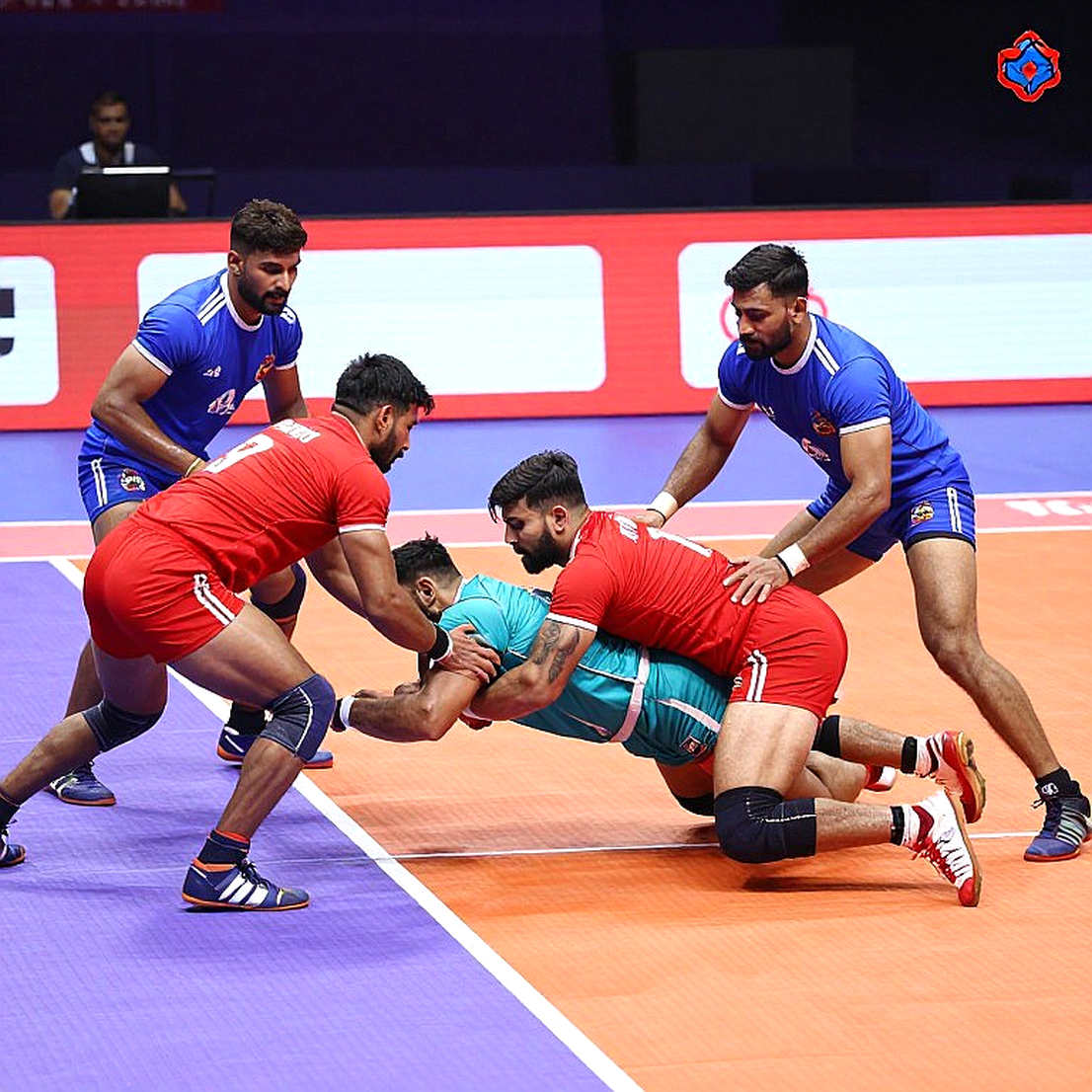
For readers new to the sport, kabaddi is a seven-a-side contact sport played on a 13m by 10m court. A raider enters the opponent’s half, must touch a defender and return within 30 seconds while chanting kabaddi continuously. A touch scores one point, a bonus-line crossing scores one point, a tackle scores one point, a super tackle with three or fewer defenders scores two, and an all out scores two. The breath chant is the sport’s defining rule: the raid must be completed in one continuous breath.
This event has seven teams in Group A and six in Group B. In a full round-robin, Group A teams play six matches and Group B teams play five. That asymmetry is small on paper but large in a table ranked by score difference. In the smaller group, one blowout can decide top spot. Scotland’s 29-point margin over Australia was not merely a good performance; it was a strategic need.
The arithmetic is self-consistent. Sri Lanka’s 48-21 win gives +27, India’s 46-26 gives +20, Uganda’s 45-29 gives +16. Scotland’s 59-30 gives +29, Kenya’s 48-28 gives +20. The ranking logic is victory first, then score difference. The factual layer of the report is reliable because the scores and the table match.
That same arithmetic makes the table misleading. Nigeria is fourth in Group A without playing a match. Bangladesh and Canada are third and fourth in Group B without playing. This is not a reporting error. It is a mechanical artifact: zero score difference looks better than a negative one. The practical consequence is that Bangladesh’s third place almost certainly understates its real strength. It may be the strongest side in Group B.
Format also encourages blowouts. Day-1 match totals were 89, 76, 72, 74 and 69. Scotland-Australia at 89 points sits at the high end, which points to weak structured defense on both sides. The report gives no tackle numbers or raid-success rates, so this is a directional judgment, not proof.
Lovepreet Brar’s 23 raid points account for at least 39% of Scotland’s 59-point total. Since team totals include tackle, bonus and all-out points, his share of the team’s raid points is likely above half. A 23-point raid haul in one match implies at least three or four super raids. It is an excellent individual performance.
It is not a breakout certificate. Australia conceded 59 points, the worst defensive display of the day. One match against the weakest defense is not a sustainable baseline. In Pro Kabaddi League analytics, one match sits well inside the noise band. A raider’s true level needs eight to ten matches, or a full season.
Brar’s name also carries a tactical clue. Scotland’s kabaddi ecosystem draws heavily on the British Punjabi diaspora, whose domestic culture is rooted in circle style. Circle style uses a circular field and one-on-one attack and defense. Standard style demands seven-a-side positional defense, bonus-line awareness and 30-second breath discipline. Diaspora players must adapt. The 89-point Scotland-Australia match may reflect that adaptation gap, but this is a hypothesis, not a confirmed fact.
The African results deserve more attention than the report gives them. Kenya beat Singapore 48-28 and Uganda beat Malaysia 45-29. Two African wins over Asian opponents on the same day is a small but real signal. In the standard internationalization narrative, African teams are cast as participants, not competitors. Kenya and Uganda challenged that assumption for one day.
It would be wrong to overread it. One match each, with no tackle or raid data, cannot establish a power shift. The correct conclusion is that these teams are worth tracking. If Kenya or Uganda produces a similar score against a structured defense, the signal becomes stronger.
India’s 46-26 win over England is unreadable as presented. A 20-point margin is solid but not dominant by India’s standards. Sri Lanka’s +27 was larger. The decisive missing variable is squad composition. The report does not say whether India fielded a senior national team or a development side. Without that, the scoreline supports no conclusion.
The report also gives no individual statistics for any Indian player. That is an editorial signal. A report with every score but no Indian raider or defender likely comes from a results feed or points table, not from match reporting. That is a limit, not a crime.
The Commonwealth label is the biggest structural point. It is a membership label, not a Commonwealth Games Federation sanction. Kabaddi is not on the Commonwealth Games programme. The report mentions no CGF affiliation. This event is not a Commonwealth Games-level competition in the usual sense.
The label works as a filter. It excludes Iran, kabaddi’s clear second power and the only nation to break India’s men’s Asian Games gold monopoly. Iran is not a Commonwealth member. It also excludes South Korea, a systematic force in Asian kabaddi. India can win this event and should win it. Without Iran, that win cannot tell us where India stands at the top level. Every preview should name Iran as co-favourite. This table is not a substitute for that argument.
The data vacuum is another story. The report has no raid-success rate, no tackle points, no super tackles, no all-out count, no lineups, no substitutions. It has one individual stat. The Pro Kabaddi League has built India’s best non-cricket analytics culture, but this event has no such ledger. Circle-style, women’s and non-league kabaddi often lack that data. Absence of data is not absence of the game.
Qualification rules are not stated. We do not know how many teams advance, whether there is a semifinal, or how much score difference matters. That is a confirmed information gap. Without it, the strategic meaning of the table is incomplete.
Here is the strongest counterargument. This is a development event. Smaller teams need exposure. Blowouts and uneven matches are natural. That is fair. The event may aim for international participation, not PKL-level depth. For weaker teams, the experience has value.
I accept that, with a limit. Development and confusion are different things. If the table shows Nigeria fourth and Bangladesh third without playing, the reader should be told why. If the format rewards big margins, that should be written too. Calling it a small tournament does not excuse a misleading table.
I also accept that Brar may be a genuine talent. Twenty-three raid points are not easy at any level. He may prove to be the best raider of the event. My argument is not that he is bad. My argument is that one match against the weakest defense is not enough to crown him. The hot take is easy. The tape is where the argument earns its keep.
I went looking for a villain in the data. I found a system instead. The table, the format, the label and the missing data together tell a story in which blaming one player or one team is easy, but the problem is structural.
Three testable predictions follow. Bangladesh will challenge Scotland and Kenya for top spot in Group B; even if it loses one match, its real level will look higher than third place. Scotland’s margin will shrink against a structured defense; 59-30 will not be repeated every day. India’s real test is not here. Without Iran, calling an India win ‘dominance’ is premature.
The organisers have one clear task: transparency. Publish qualification rules, raid-success rates, tackle points, super tackles, lineups and the strategic weight of score difference on one page. That would turn the table into news instead of confusion. Kabaddi’s international growth can happen without those numbers. Its analysis cannot.
The question is whether we read the Day-1 table as a measure of strength or as a mirror of its format. For me, the answer is clear. The next time someone says Sri Lanka is ahead of India or Scotland has found a star, ask: what is the sample, what was the defense, and what are the rules? Kabaddi’s real story begins where the scoreboard stops.
संबंधित खिलाड़ी
अनुशंसित
39 and 23: Ahmedabad's First Commonwealth Kabaddi Championship and the Entry-List Arithmetic That Doesn't Reconcile2026-10-26
Surjeet Singh captain, Naveen Kumar deputy: the Ahmedabad command, and the ledger the announcement left out2026-10-24
Thirteen Names and One Empty Corner in Ahmedabad: The Format Question Behind Pakistan's Withdrawal2026-10-23
India vs Uganda: The Scorecard Says 46–26. The Number That Matters Is 26.2026-10-26
Commonwealth Kabaddi Championship 2026 Day 1: The Real Story Is Format, Data and Iran’s Absence, Not the Points Table2026-10-28
अनुशंसित
Commonwealth Kabaddi Championship 2026 Day 1: The Real Story Is Format, Data and Iran’s Absence, Not the Points Table2026-10-28
39 and 23: Ahmedabad's First Commonwealth Kabaddi Championship and the Entry-List Arithmetic That Doesn't Reconcile2026-10-26
Commonwealth Kabaddi Championship: The Arithmetic of 62 Matches in Ahmedabad, and the Incomplete Maths of the Women's Draw2026-10-23
Surjeet Singh Captain, Naveen Kumar Deputy: Ahmedabad's Nine Days and the Absence That Defines Them2026-10-23
Pakistan Struck From the Entry List: Three Questions the Commonwealth Kabaddi Championship Has No Register to Answer2026-10-23
अनुशंसित
39 and 23: Ahmedabad's First Commonwealth Kabaddi Championship and the Entry-List Arithmetic That Doesn't Reconcile2026-10-26
Surjeet Singh Captain, Naveen Kumar Deputy: The Column the Ahmedabad Release Left Blank2026-10-23
Commonwealth Kabaddi Championship 2026 Day 1: The Real Story Is Format, Data and Iran’s Absence, Not the Points Table2026-10-28
Commonwealth Kabaddi Championship: The Arithmetic of 62 Matches in Ahmedabad, and the Incomplete Maths of the Women's Draw2026-10-23
Surjeet Singh captain, Naveen Kumar deputy: the Ahmedabad command, and the ledger the announcement left out2026-10-24