
होमKabaddiIndia vs Uganda, Commonwealth Kabaddi Championship 2026 Match 9: India Must Not Take Uganda Lightly, But the Real Questions Are About Level and Claims
India vs Uganda, Commonwealth Kabaddi Championship 2026 Match 9: India Must Not Take Uganda Lightly, But the Real Questions Are About Level and Claims
भारत बनाम युगांडा मैच 9, कॉमनवेल्थ कबड्डी चैंपियनशिप 2026: भारतीय पुरुष कबड्डी टीम का सामना युगांडा से होगा। भारत ने अपना पहला मैच इंग्लैंड के खिलाफ 46-26 से जीता था, जबकि युगांडा ने मलेशिया को 45-29 से हराया था। भारत भारी पसंदीदा है, लेकिन दो अहम बातें ध्यान में रखनी चाहिए: पहली, इस टूर्नामेंट में ईरान, बांग्लादेश और दक्षिण कोरिया जैसी शीर्ष टीमें नहीं हैं, इसलिए यहां का दबदबा भारत की वैश्विक ताकत का सही पैमाना नहीं है; दूसरी, रिपोर्ट में किया गया 'एशियाई खेल 2026 स्वर्ण पदक विजेता' का दावा तथ्यात्मक रूप से संदिग्ध है, क्योंकि एशियाई खेल 2026 का आयोजन अभी नहीं हुआ है — भारत का सबसे हालिया स्वर्ण 2022 के हांगझोउ एशियाई खेलों (आयोजन 2023) में आया था। यह भी ध्यान दें कि कबड्डी कॉमनवेल्थ गेम्स का आधिकारिक खेल नहीं है; यह आयोजन एक स्वतंत्र आमंत्रण-आधारित प्रतियोगिता है। खिलाड़ियों के नाम या व्यक्तिगत आंकड़े उपलब्ध नहीं हैं।
India's men's kabaddi team faces Uganda in Match 9 on Day 2 of the Commonwealth Kabaddi Championship 2026. On paper it is a lopsided fixture — a top-two side in the world against an emerging African nation. But the real story of this match is not on the scoreboard; it lies in the questions surrounding the tournament's level, its branding, and the claims being made about India.
India opened with a convincing 46-26 win over England, a 20-point margin that suggests dominance in raiding and depth in squad. Reports indicate India fielded a fresh, rotated side and still made a strong start. That says two things: India's domestic pipeline is wide enough that a second-string side faces no real threat at this level; and the 46-26 scoreline should not be read as proof of India's full strength — when you are experimenting, a 20-point win reflects a floor, not a ceiling.
Uganda were no less impressive in their opener, beating Malaysia 45-29. A 16-point win with 45 points scored shows a raiding unit that can actually put points on the board. That makes them a more uncomfortable opponent than a purely defensive side, because scoring teams raise the risk of all-outs and can change the shape of a match once momentum arrives.
In this four-nation field, Uganda are the strongest non-India team, which makes this a de-facto test against the best of the rest. Hence the cautionary framing that India cannot afford to take Uganda lightly. The caution is reasonable, but should be sized correctly: not because Uganda can beat India, but because the real question is whether India can maintain structure, discipline and defensive rhythm against a weaker side.
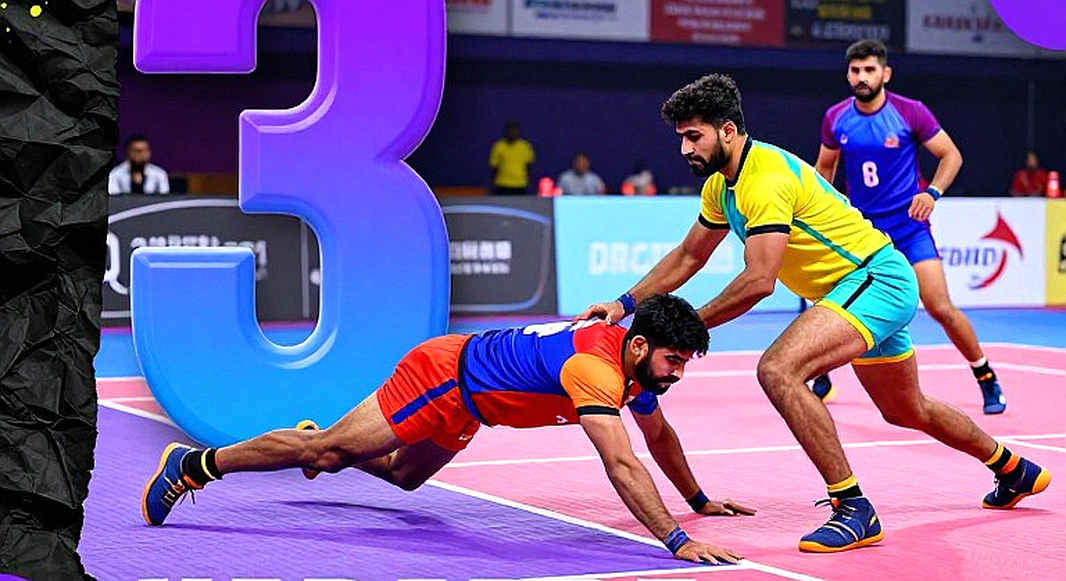
Understanding the rules matters here. Seven players a side; raids and tackles alternate. A raider crosses into the opponent's half, must touch a defender and return safely within 30 seconds, chanting 'kabaddi' continuously — the cant — to prove he is not taking a breath; if the chant breaks, the raid is void. A successful tackle earns a point and sends the raider off. An all out — all seven of one side out simultaneously — earns the opponent two bonus points and revives the wiped-out side, the mechanism that rapidly inflates scores. The bonus line earns a point only when defenders number six or more; a super tackle, completed with three or fewer defenders, is worth two.
Read through these rules, the scorelines are themselves analysis. Totals of 46 and 45 imply multiple all-outs by the losing sides — 46-26 and 45-29 point to repeatedly broken defences and open, high-tempo matches rather than the low-scoring grind of elite Iran-versus-India fixtures. But there is a quiet warning for India too: conceding 26 against England suggests looseness inside a 20-point win. Against stronger sides that looseness becomes decisive. Uganda conceded 29 against Malaysia, so neither defence looks secure — raising the likelihood of another high-scoring game and making India's defensive improvement the thing to watch.
Notably, no player is named anywhere in the coverage — no raider, no defender, no captain, no statistics. That is not just an editorial gap; it signals the event's tier. PKL coverage is saturated with player data; here there is none, because the event carries no star power. As a result, no assessment of raid efficiency, do-or-die efficiency or single-point dependency is possible for either side, and all tactical conclusions remain low-confidence.
The bigger limitation is the field itself. India's genuine rivals — Iran, Bangladesh, South Korea, and Pakistan — are absent. A dominant India against England, Uganda and Malaysia says little about India's standing against the elite. This field reflects geographic spread, not the sport's real power hierarchy, which is still settled at the Asian Games and world championships.
A clarification is essential: kabaddi is not a Commonwealth Games sport and has never been a medal event at any edition. A 'Commonwealth Kabaddi Championship' is therefore an independent invitational borrowing the label for prestige and marketing, not an official Commonwealth Games Federation competition. The organiser is not named. In real competitive terms, the event sits below the Asian Championship and should be read accordingly.
There is also a serious factual flag. The report describes India as the 'Asian Games 2026 gold medallists'. The 2026 Asian Games (Aichi-Nagoya) had not been held at the apparent time of publication; India's most recent men's kabaddi gold came at the 2026 Hangzhou Games, held in 2026. The claim is likely a conflation and should be verified against official results before being repeated.
Regionally, Uganda and Kenya are Africa's most active kabaddi nations, and their presence reflects decades of deliberate outward promotion by Indian kabaddi bodies and diaspora organisations — a genuine, not fabricated, indicator of the sport's African reach. England and Malaysia, by contrast, are effectively diaspora teams: Malaysian kabaddi is tied to its large Tamil-Indian community, and English kabaddi is community-driven rather than mass-participation. So this fixture should not be read as evidence of kabaddi going global in any deep sense; what is visible is largely an Indian-diaspora footprint, with Uganda the most honest indicator of organic expansion. Note also that only the men's tournament is referenced; no parallel women's competition is mentioned, so nothing can be concluded about the women's game.
Commercially, the event is small and the report carries no figures — no broadcast rights, no sponsors, no player contracts, no attendance data. There is no auction, because PKL-style player auctions are a domestic league feature. The article's closing appeal — follow on Facebook, Twitter and Instagram, download the app, join WhatsApp and Telegram — reveals its true function: a live-traffic and audience-aggregation asset, monetised indirectly through app installs and social follows, not through event value.
Governance cannot be audited from this article: no organiser, federation, officiating framework, anti-doping provision or review mechanism is described. The one clear governance-adjacent fact is negative — the 'Commonwealth' branding is not backed by any stated official framework, and the organiser is unnamed. Olympic pathway relevance is close to zero, since an event of this size does nothing for the hard criteria — number of participating countries, continental coverage, women's development — that kabaddi has historically struggled to meet.
The risk picture is therefore dominated by information integrity: the Asian Games 2026 claim is the primary flag. Second is narrative over-extension — reading dominance against a weakened, diaspora-driven field as proof of global supremacy. Third is the defensive signal hidden in the scorelines — conceding 26 is not a detail to be skipped. Fourth is prestige inflation through branding. Absolute risk remains contained because the competitive and commercial stakes are low.
What to track: India's defensive concession rate against stronger sides; Uganda's consistency against non-India opposition; confirmation of the organiser and sanctioning body; whether 'fresh squad' players are retained for bigger events, which would reveal whether this is a genuine selection gateway; and whether a women's bracket exists at the same event.
In short, India are heavy favourites and should win. The real story is that the tournament's level, its branding and the claims attached to it all point the same way — kabaddi's international expansion is real, but it is currently expansion of participation, not of competitive depth. And the Asian Games 2026 reference demands verification. The right way to watch this match is not to measure the probability of an Indian win, but to see how India win and whether that win contains lessons for the fixtures that actually matter.
संबंधित खिलाड़ी
अनुशंसित
Thirteen Nations in Ahmedabad After Pakistan's Exit: The Real Map of the Commonwealth Kabaddi Championship2026-10-30
First Commonwealth Kabaddi Championship in Ahmedabad: 13 Nations, 62 Matches, and the Count of Twenty-Three Nobody Announced2026-10-23
Volume Is Not Capacity: Kabaddi Coverage's Blind Spot2026-10-24
Commonwealth Kabaddi Championship 2026: Before India vs Nigeria, the 42-Point Truth Hidden Behind the Scorelines2026-10-27
India vs Uganda: The Scorecard Says 46–26. The Number That Matters Is 26.2026-10-26
अनुशंसित
Surjeet Singh Captain, Naveen Kumar Deputy: Ahmedabad's Nine Days and the Absence That Defines Them2026-10-23
Pakistan Struck From the Entry List: Three Questions the Commonwealth Kabaddi Championship Has No Register to Answer2026-10-23
The Auction Hammer Doesn't Measure Performance: Kabaddi's Transfer Window Still Sells on Reputation2026-10-30
Commonwealth Kabaddi 2026: India Tests Its Bench, But Without Iran the Test Is Incomplete2026-10-24
39 and 23: Ahmedabad's First Commonwealth Kabaddi Championship and the Entry-List Arithmetic That Doesn't Reconcile2026-10-26
अनुशंसित
First Commonwealth Kabaddi Championship in Ahmedabad: The 23 Women's Matches Suggest Three Nations Are Not Sending Women's Teams2026-10-30
Thirteen Names and One Empty Corner in Ahmedabad: The Format Question Behind Pakistan's Withdrawal2026-10-23
Surjeet Singh captain, Naveen Kumar deputy: the Ahmedabad command, and the ledger the announcement left out2026-10-24
One Name Missing From Ahmedabad: Pakistan's Withdrawal and the Ledger of Kabaddi's Hollow Field2026-10-30
India vs Uganda, Commonwealth Kabaddi Championship 2026 Match 9: India Must Not Take Uganda Lightly, But the Real Questions Are About Level and Claims2026-10-31